TurQuosian

Aegean

Ephesus

A facade, a street, and a buried harbour

Ephesus is Türkiye’s single most-visited ancient site, a Roman-era metropolis you walk downhill through rather than a monument you photograph once. Base yourself in Selçuk, not Kuşadası — nearly everything that matters, including the museum that explains the ruins, is here. Go for the gate at 08:00: cruise coaches fill the site from mid-morning, and the marble gives back the heat all afternoon.

Stay
2 days
Best months
Apr–Jun, Sep–Nov
Airport
ADB

Every published place in one city guide

What to see in Ephesus.

Start with the essentials, add what genuinely interests you, and leave the rest for another visit. Every place includes a concise story, practical timing, a Maps link, and a one-tap route planner action.

Make the route work

Anticipate the practical details.

Getting there

Base yourself in Selçuk. The nearest airport is İzmir Adnan Menderes (ADB), roughly an hour by road or by a direct train and transfer; intercity buses also connect İzmir to Selçuk. Many visitors instead arrive on a cruise call at nearby Kuşadası — if you do, expect the site to fill with ship groups from mid-morning.

Getting around

The site runs downhill from south to north: enter at the upper (south) gate, walk down, and leave by the lower (north) gate — gravity works with you and the city unfolds in the order it was built to be seen. The two gates sit about 3km apart by road and no dolmuş reaches the upper gate, so take a taxi there from Selçuk and a dolmuş back from the lower gate.

Money

Carry a payment card and some Turkish lira. The Terrace Houses need a separate ticket on top of Ephesus admission — museum passes do not cover it — so confirm current prices at the gate rather than an older guide.

Connectivity

Mobile coverage is reliable in Selçuk and across the archaeological site. It can weaken on the back road up to the House of the Virgin Mary, so download offline maps before that trip.

Etiquette

İsa Bey Mosque and the House of the Virgin Mary are active places of worship — dress modestly and time visits around prayer where relevant. Don't sit on the public latrines' marble seats for photographs, and respect fenced-off areas; several are closed for genuine safety or conservation reasons, not bureaucracy.

Safety and comfort

There is almost no shade on the main route, and the marble reflects the heat back — recorded summer maxima reach the low 40s°C, so carry water and start early. The Cave of the Seven Sleepers and the Great Theatre interior are fenced for real safety reasons; do not climb in through a gap.

Essential

Don’t leave without

If you only have one day, this is the day.

Rank1
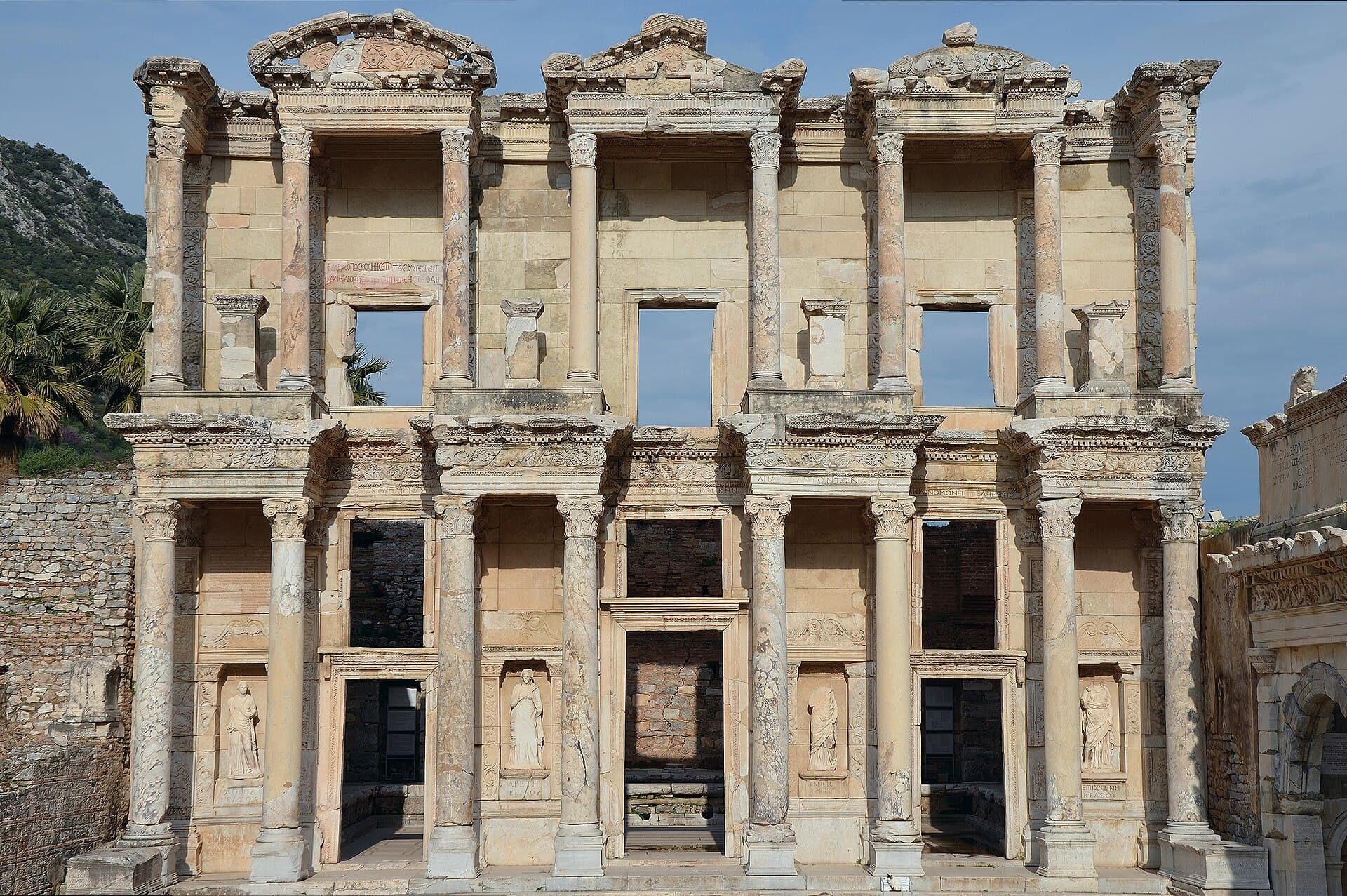
Straight-on view of the fully reconstructed two-storey marble facade of the Library of Celsus at Ephesus, with all four Corinthian-columned bays, the four statue niches, and a clear blue sky behind, wooded hillside to the left.

Library of Celsus

Archaeological site

The facade is real stone, reassembled from its own fallen fragments in the 1970s. Everything behind it is still ruin.

Begun about AD 110 by Tiberius Julius Aquila as a monument and tomb for his father, the proconsul Celsus Polemaeanus, whose sarcophagus still lies in a vault beneath the reading room. It held some twelve thousand scrolls. Fire gutted the interior in AD 262 and an earthquake felled the front. Volker Michael Strocka rebuilt the facade between 1970 and 1978 from fragments Austrian excavators recovered in 1903–04.

No separate ticket; inside the Ephesus site (€40).

30 minThe direct route from the library to the Great Theatre has been closed since April 2025 for restoration, forcing a detour through the Commercial Agora.The plaza in front of the facade is the most congested spot in Ephesus; from roughly 10:00 to 14:30 in season it is a standing queue of tour groups waiting for the same photograph.Only the facade stands. There is no interior, no reading room and no upper floor to enter.
+1 more to know
No shade anywhere on the plaza, and the polished marble reflects hard through the middle of the day.
Look for: The four female statues in the niches are copies; the originals went to Vienna in 1910. Left of the facade, the triple-arched gate into the agora was paid for by Mazaeus and Mithridates, two of Augustus's freed slaves.
Verified · · 1 min to Curetes Street · 3 min to Terrace Houses of Ephesus
Rank2
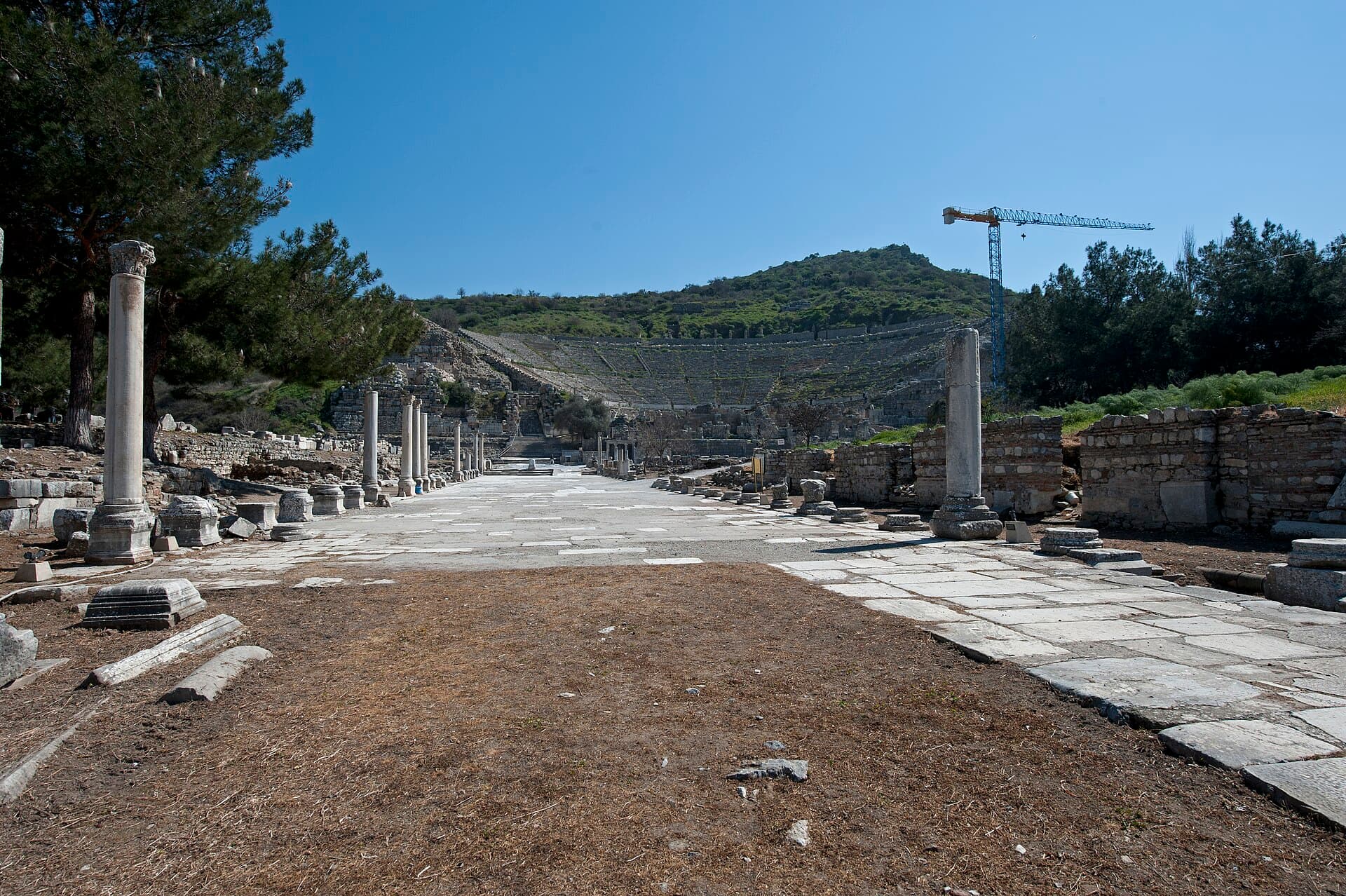
Colonnaded Arcadiane (Harbour) Street at Ephesus leading toward the Great Theatre, whose tiered stone seating rises into the green hillside in the distance.

Great Theatre of Ephesus

Archaeological site

The largest theatre of the ancient world — and since April 2025 you have been looking at it from the agora, not sitting in it.

Cut into the slope of Panayır Dağı in the Hellenistic period and enlarged under the Romans into a bowl of sixty-six rows in three tiers, fronted by a stage building three storeys and eighteen metres high. In Acts 19 the silversmith Demetrius, whose trade was shrines of Artemis, drove a mob here chanting against Paul until the town clerk broke it up.

No separate ticket; inside the Ephesus site (€40).

20 minInterior access has been closed since April 2025 for restoration and was still closed as of mid-2026, with no announced reopening date. You view the theatre from outside, via the Commercial Agora.The Ministry's own page lists no closure at all. Do not take an official listing as confirmation that you can go in — check on arrival.The direct road between the Library of Celsus and the theatre is closed with it; the detour runs through the Commercial Agora.
+1 more to know
Completely unshaded, and the approach traps heat through the middle of the day.
Look for: Harbour Street running dead straight away from the stage building toward a flat green plain — that plain was the harbour, before silt from the Küçük Menderes pushed the coast three to four kilometres west.
Verified · · 4 min to Library of Celsus · 5 min to Terrace Houses of Ephesus
Rank3
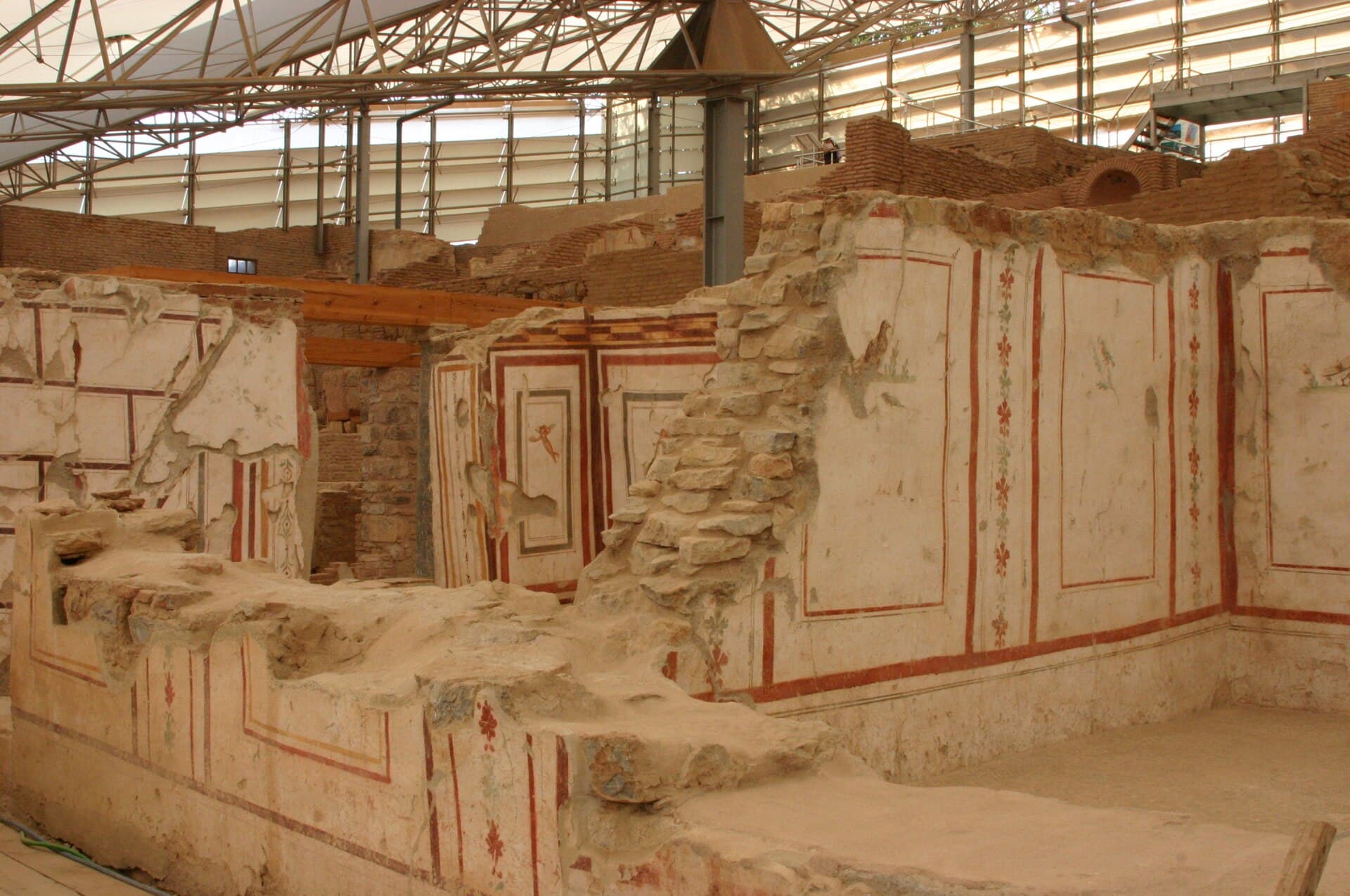
Close-up of Roman-era frescoed walls in the Terrace Houses at Ephesus, showing red-bordered decorative panels with floral garland motifs, preserved beneath the site’s protective roof structure.

Terrace Houses of Ephesus

Archaeological site

Roofed, shaded and comparatively empty — the only part of Ephesus with a ceiling, and the only part behind a second ticket.

Six terraced houses on the slope facing the Temple of Hadrian, built from about 200 BC on Hellenistic terracing and occupied by wealthy Ephesians from the first century BC into the seventh AD. Two blocks have been excavated. They hold the largest body of Roman floor mosaic in western Türkiye, and frescoes of Apollo, the Muses and Socrates painted directly onto the plaster of ordinary rooms.

Separate €15 ticket on top of the €40 site entry — there is no combined ticket. Discounted to 200 TL for MüzeKart holders.

45 minOpening hours are offset from the main site: it opens later and closes roughly an hour earlier, so arriving late in the day means finding it shut while Ephesus is still open.A separate ticket is required on top of Ephesus admission, and the museum passes do not cover it — the supplement is charged even to pass holders.Excluded from the night museum programme. A summer evening visit to Ephesus means no Terrace Houses at all.
+1 more to know
The route is a system of raised metal and glass walkways with repeated flights of steps between terraces.
Look for: Glass walkways run above the floors, so you look down through the layers rather than across them. Look for the marble-panelled hall and the mosaic floors, and for restorers piecing wall plaster back together.
Verified · · 1 min to Curetes Street · 3 min to Library of Celsus
Rank4
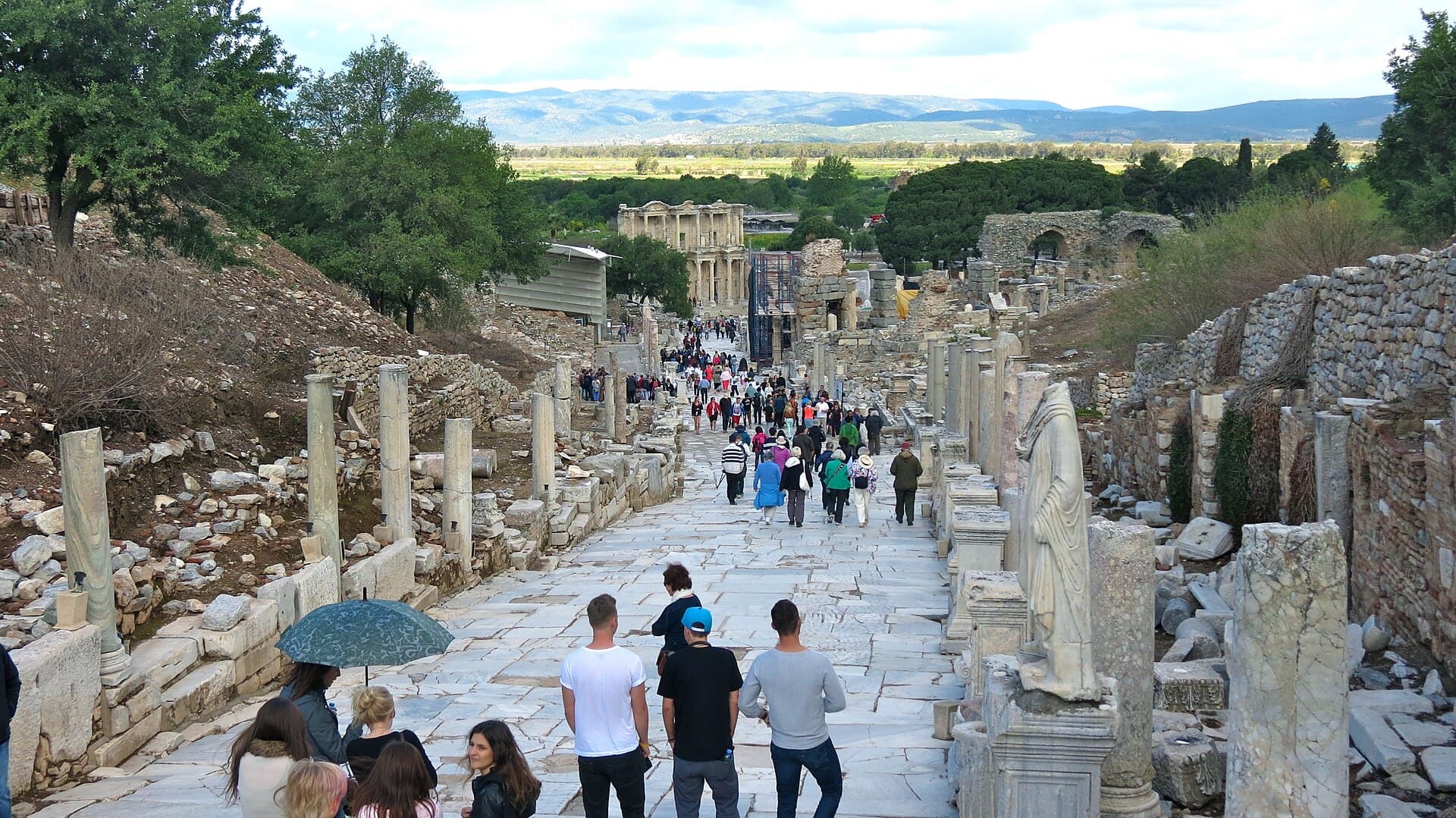
A downhill view along the marble-paved Curetes Street at Ephesus, lined with columns and ruined building facades on both sides, with the two-story facade of the Library of Celsus visible in the distance and tourists walking down the slope.

Curetes Street

Archaeological site

The 210-metre marble spine of the city. Walk it downhill and Ephesus makes sense; walk it uphill and it is just a slog.

The processional street between the Hercules Gate and Triodos Square by the library, 210 metres long and 6.8 to 10 metres wide, dropping about 20 metres. Paved in marble in the Roman period over the city's drainage system. From the fourth century AD the Hercules Gate narrowed the top end so that wheeled traffic could no longer pass, and the street became a pedestrian promenade.

No separate ticket; inside the Ephesus site (€40 for foreign visitors, card or Turkish lira only — euro cash is not accepted at the gate).

45 minPolished marble on a sustained gradient. Worn paving is genuinely slippery in the wet and awkward in smooth-soled shoes.The whole 210 metres is unshaded, and it is the stretch where the marble reflection is worst.Walked from the lower gate this is a continuous climb of about 20 metres on uneven ancient paving — the single strongest argument for entering at the upper gate.
+1 more to know
The narrow section where the street meets the library plaza is where downhill walkers meet arriving cruise groups head-on in late morning.
Look for: Circular hollows and scored grooves cut into the marble — anti-slip texturing, for winter rain and for feet on hot polished stone. Mosaic sidewalks and column stumps mark the shopfronts on both sides.
Verified · · 1 min to Library of Celsus · 1 min to Terrace Houses of Ephesus

Worth your time

Worth your time

A second day earns you these.

Rank1
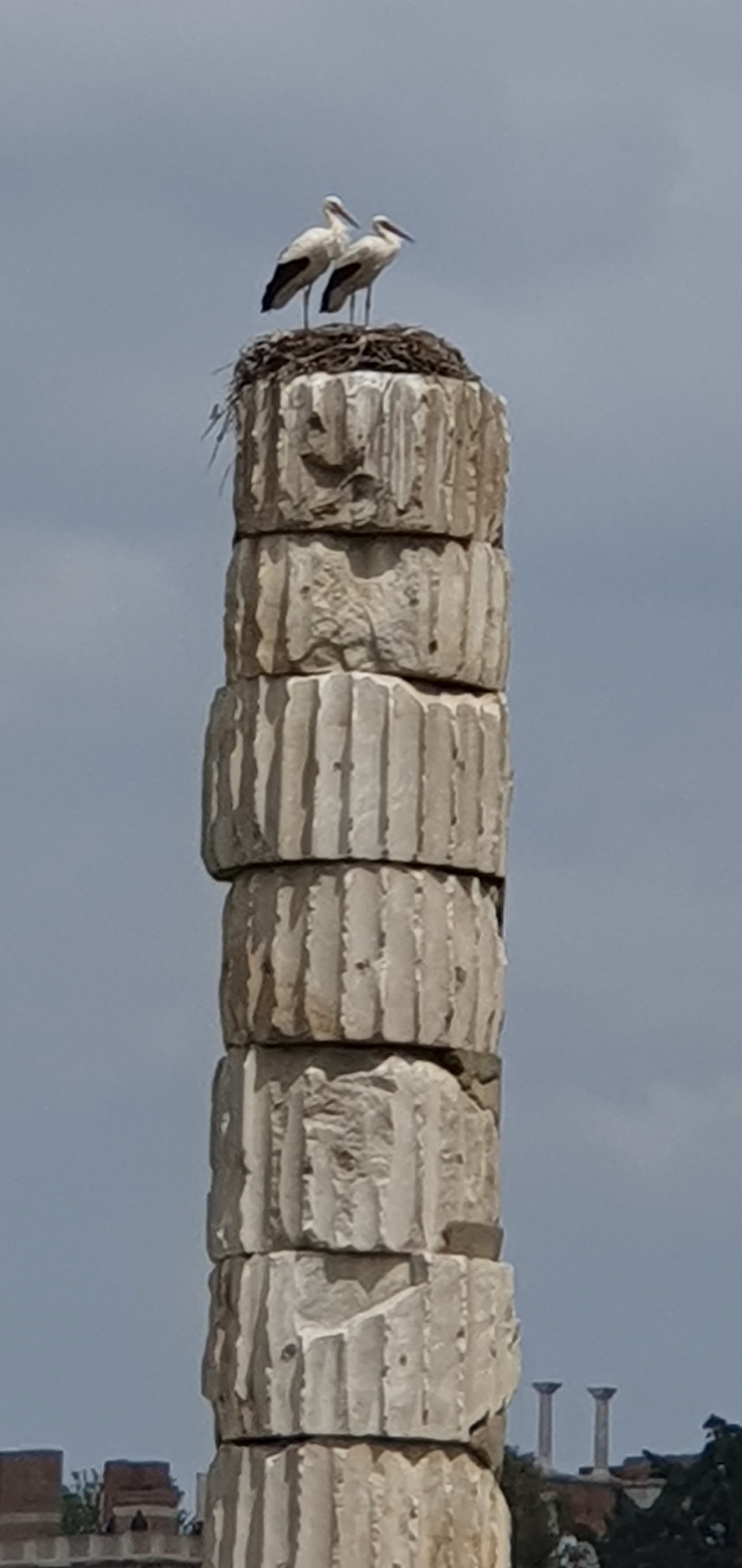
A single ancient column made of mismatched stacked stone drums, standing alone at the ruined site of the Temple of Artemis near Ephesus, Turkey, topped by a large stork nest against a plain blue sky.

Temple of Artemis

Archaeological site

One of the Seven Wonders of the Ancient World is now one column in a wet field. Go anyway, but go knowing that.

Antipater of Sidon ranked it above every other wonder he had seen. Rebuilt three times, the last version begun about 323 BC and standing some six centuries before it was destroyed in AD 401. Its stone was quarried away for later buildings. The best surviving sculpture was carried to the British Museum in the nineteenth century and sits in its Ephesus room.

Free; open site, no gate.

20 minExpect a field, a single re-assembled column and an information board. There is no standing structure, no enclosure and no visitor building. This is the most common disappointment of an Ephesus trip.The site sits on low, marshy ground and the foundations hold standing water after rain, particularly in winter and spring — footwear matters more here than the size of the site suggests.Roadside sellers work the layby, and this is one of the few spots around Selçuk where visitors are approached persistently.
+1 more to know
Fifteen to twenty minutes covers it. Anyone planning an hour has misjudged the site.
Look for: The single column is a modern assembly of mismatched drums found on site — not one original shaft. In spring the foundations flood, and the low marble blocks around it trace a footprint four times that of the Parthenon.
Verified · · 14 min to Ephesus Archaeological Museum · 16 min to Basilica of St John
Rank2
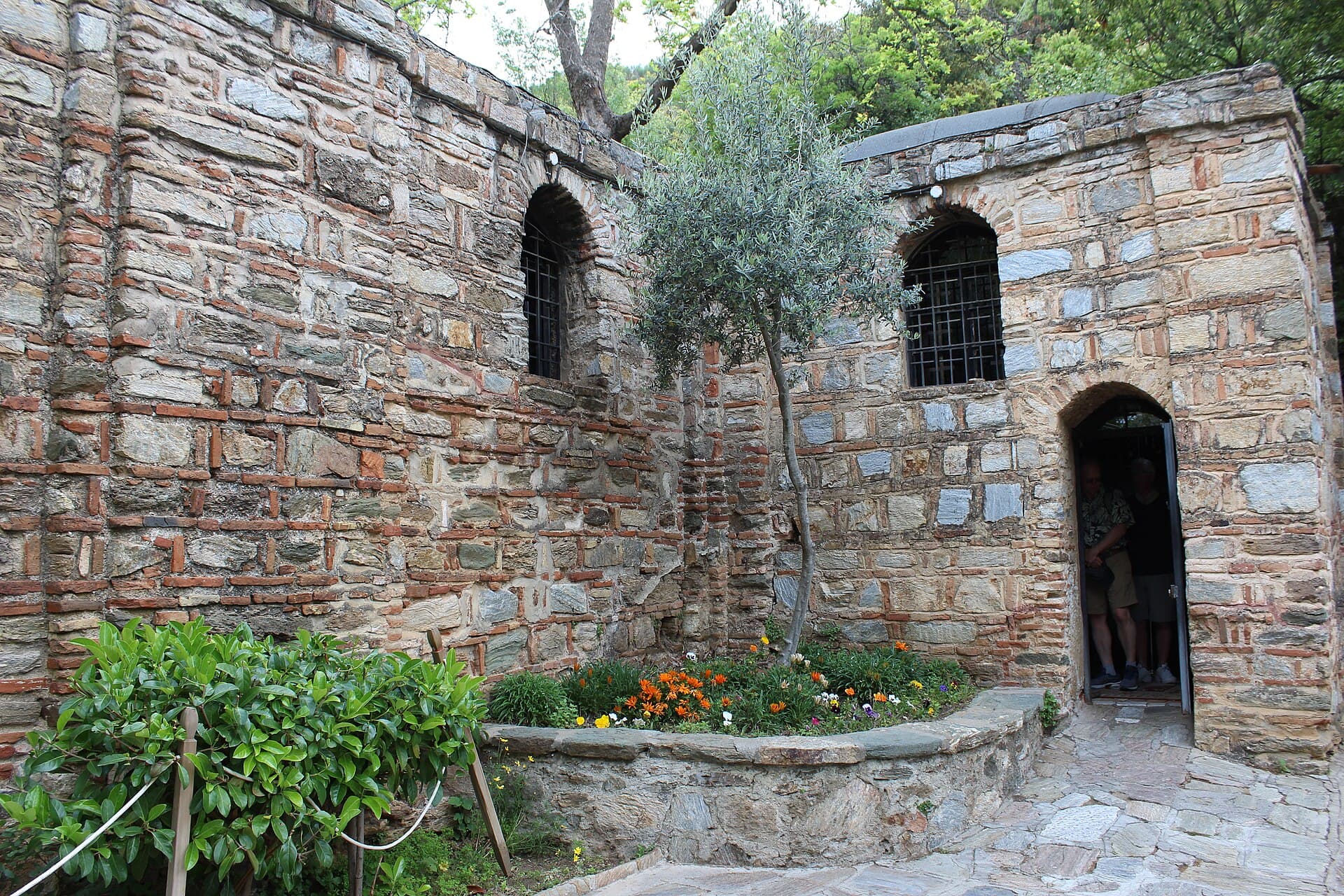
Exterior stone wall of the House of the Virgin Mary chapel near Ephesus, Turkey, showing two barred windows, an open doorway with visitors inside, and an olive tree growing beside the entrance.

A small stone chapel on Bülbül Dağı that three popes have visited and that Muslims and Christians venerate together.

Found in 1881 by the French priest Julien Gouyet, working from the visions of Anne Catherine Emmerich, a bedridden German nun who had never been to Anatolia and whose descriptions were published in 1852. Rome declared it a Holy Place in 1951 but has never ruled on whether Mary lived here. Paul VI came in 1967, John Paul II in 1979, Benedict XVI in 2006.

700 TL per person, card payment only. Privately run — not a state site, and NOT covered by MüzeKart or the Aegean pass.

45 minPrivate vehicles cannot drive up to the house — everyone transfers to a shuttle at the entrance gate.No dolmuş runs to the shrine gate. Summer minibuses from Selçuk reach the upper road only; from Selçuk or Ephesus the last stretch needs a taxi or an organised tour.The chapel interior is very small and silence is expected inside; when two coaches arrive together it becomes a slow single-file queue.
+2 more to know
It is an active shrine with Mass celebrated on site, not a museum. Covered shoulders and knees are the norm.On the same road as the Ephesus upper gate, which makes it easy to combine — and means it fills with the same cruise groups at the same hours.
Look for: The wishing wall below the chapel, layered with paper and cloth left by both faiths, and the spring taps beside it. Private cars stop at the gate; a shuttle covers the last stretch up the mountain.
Rank3
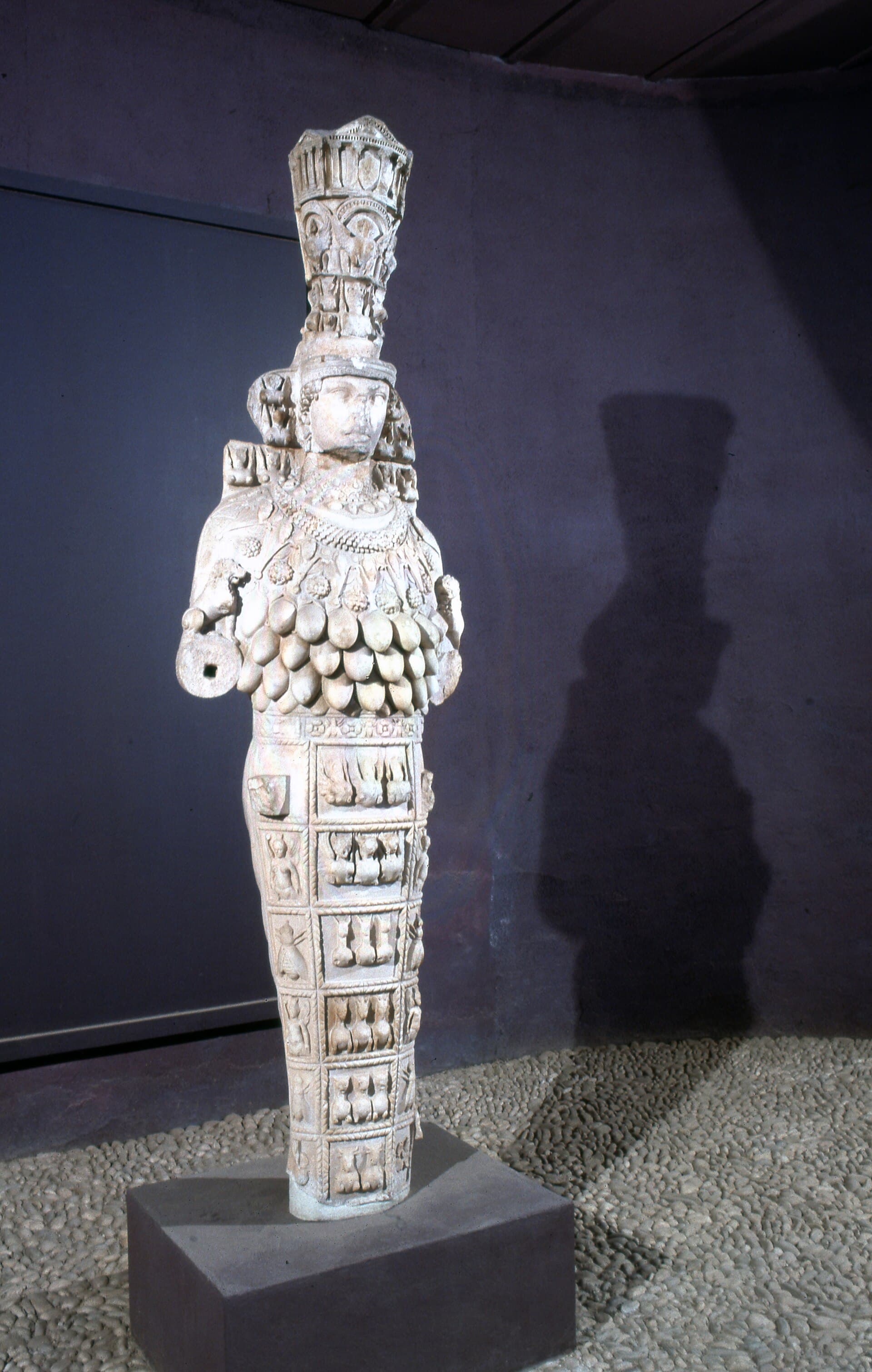
The "Great Artemis" (Colossal Artemis) statue at the Ephesus Archaeological Museum in Selçuk, Turkey — a weathered marble cult statue shown full-length with a tall tiered headdress, an ornate collar, rows of round egg-like ornaments down the torso, and a paneled skirt, standing in a dark museum gallery.

Everything portable that was lifted off Curetes Street ended up here, indoors, a short walk from where it stood.

Selçuk's museum holds the movable finds from more than a century of excavation at Ephesus, arranged by where they were found rather than by date. It closed for rebuilding in 2012 and reopened in December 2014 with new galleries and bilingual labelling.

Ticketed; €10 for foreign visitors. MüzeKart valid; covered by the Aegean pass.

75 minMost of what is famous at Ephesus is here rather than there — the Temple of Hadrian friezes and the Terrace Houses finds among them. Visiting the site without the museum leaves you looking mainly at casts.The Artemis statues are displayed in a deliberately darkened room, which defeats most phone cameras.It is in Selçuk town, not at the archaeological site, and needs a separate journey from the ruins.
+1 more to know
Indoor and the obvious refuge from midday heat, which also makes it busiest in the early afternoon in summer.
Look for: The two Artemis statues, Colossal and Beautiful, lit facing each other in a dark room. Also the original Temple of Hadrian reliefs — what stands on Curetes Street is a cast — and the bronze Eros on a dolphin.
Verified · · 8 min to Basilica of St John · 14 min to Temple of Artemis
Rank4
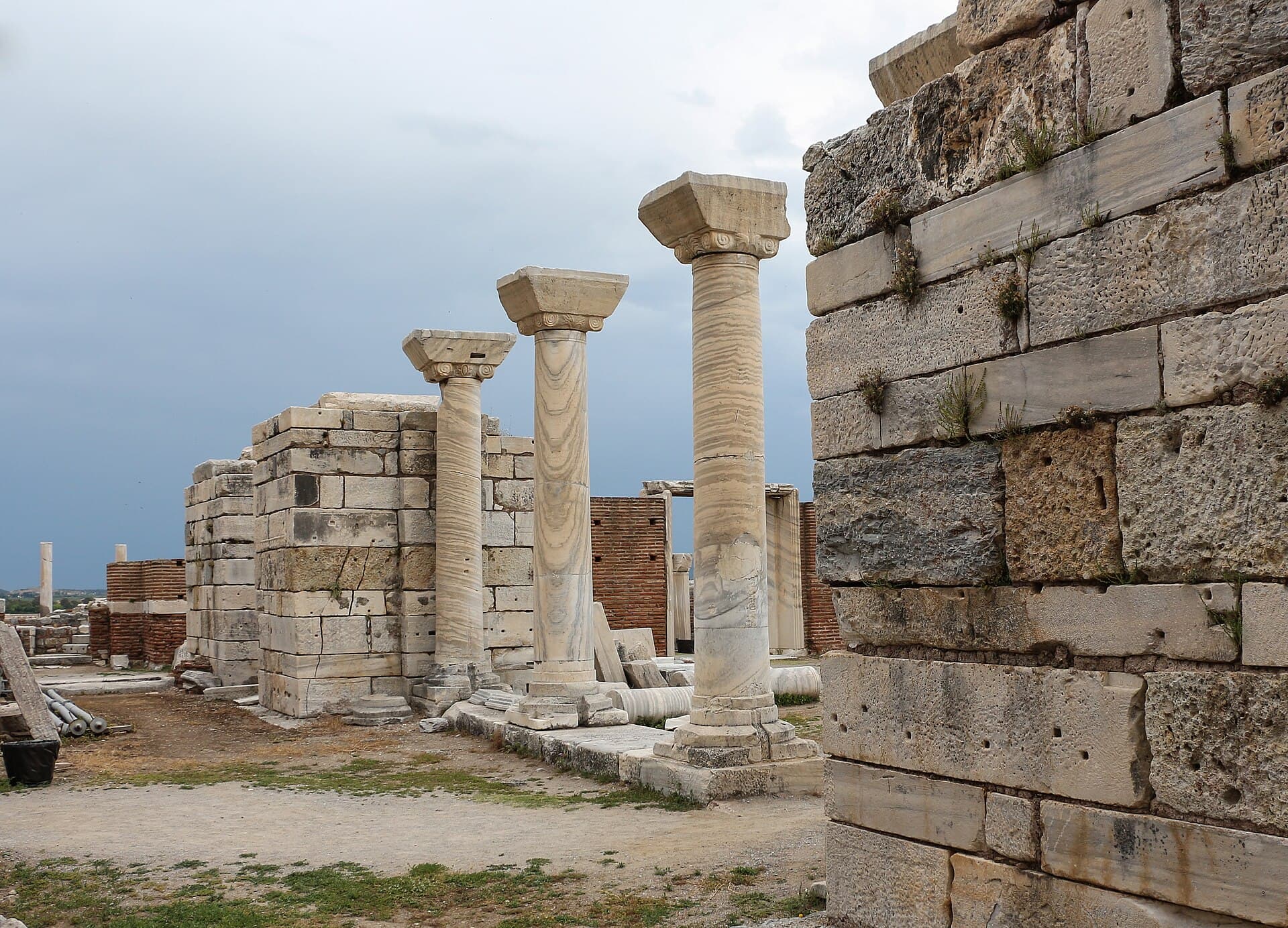
Three tall re-erected marble columns with carved Ionic-style capitals stand among the ruined stone and brick walls of the Basilica of St. John in Ephesus, under a partly cloudy sky.

Basilica of St John

Religious site

Justinian built a cathedral over what Ephesus believed was the grave of John the Evangelist. The grave was empty.

A domed cruciform basilica raised by Justinian from about 535 over an earlier shrine on Ayasuluk Hill, and among the largest churches of its age. Its scale drew pilgrims for centuries. It fell into ruin after earthquakes and the Turkish conquest; partial rebuilding of the walls and columns was funded from the United States after 1923.

Ticketed; €6 for foreign visitors, as part of Ayasuluk–St John site. MüzeKart valid.

60 minA roofless hilltop ruin with no shade at all. In midsummer this is an early-morning or late-afternoon site, not a midday one.You walk on and between excavated foundations on uneven, broken paving with open level changes and low walls.The tomb is a marble slab in the floor of the chancel, not a chamber or a crypt you can enter.
+1 more to know
The ticket also covers Ayasuluk Castle on the hilltop above, which many visitors miss because it is a further uphill walk from the basilica.
Look for: The marble slab over the tomb, in the raised chancel under four re-erected columns, and the octagonal baptistery to its north. You enter up the hill through the Gate of Persecution; the same ticket takes you on to Ayasuluk Castle above.
Verified · · 8 min to Ephesus Archaeological Museum · 16 min to Temple of Artemis

If you have longer

If you have longer

Keep these compact stops in mind when you build your trip.

Şirince

Neighbourhood

Called Çirkince, 'ugly', until 1926, reportedly so its Greek Orthodox inhabitants would keep outsiders away. The population was exchanged to Greece in 1923 and Muslims arriving from Greece took their place. Around 456 people live here now, in stone and plaster houses that are a rare survival of Ottoman Christian village building.

Free; village, no gate. Individual museums and tastings charge separately.

The lanes are steep, cobbled and uneven, and vehicle access into the village core is restricted.Almost every Ephesus day tour includes a few hours here, so the lanes and restaurants are at their worst between late morning and mid-afternoon.The 'homemade' fruit wines are widely reported to be industrially produced and decanted; tasting is free and worth doing before buying.
+1 more to know
Prices for food, ice cream and even toilets run well above Selçuk's.
120 minOpen in Maps

Temple of Hadrian

Archaeological site

Dedicated by P. Quintilius Valens Varius with his wife and daughter. Long dated to AD 130–132, when Hadrian granted Ephesus a temple in his name; recent reading of the dedicatory inscription pushes it back to about AD 117–119. Found in 1956, re-erected over the next two years, conserved again between 2012 and 2014.

No separate ticket; inside the Ephesus site (€40 for foreign visitors, card or Turkish lira only — euro cash is not accepted at the gate).

The relief panels on site are reproductions. The originals are in the Ephesus Archaeological Museum in Selçuk.Much of what stands is 1950s re-erection using modern stone alongside recovered fragments, not surviving fabric.It sits directly on Curetes Street beside the Terrace Houses entrance and is a standing bottleneck when groups stop to photograph it.
10 minOpen in Maps

Odeon of Ephesus

Archaeological site

Built about AD 150 by Publius Vedius Antoninus at the north edge of the State Agora, beside the Prytaneion where the city's sacred fire burned. Seating for roughly 1,400 to 1,500, roofed, and used both as the council house and for recitals. It collapsed in a fourth-century earthquake and its marble seats were carted off for other buildings.

No separate ticket; inside the Ephesus site (€40 for foreign visitors, card or Turkish lira only — euro cash is not accepted at the gate).

Reached first from the upper gate and last from the lower one — visitors entering below often turn back before getting here.The seating was restored in the twentieth century; the original marble slabs were removed in antiquity for reuse.Fully exposed, with the upper city offering no shade at all.
15 minOpen in Maps

Ayasuluk Castle

Historic site

A Byzantine fortress raised after the seventh-century Arab raids to protect the basilica below, then rebuilt by the Aydinids and the Ottomans using stone stripped from Ephesus and other abandoned sites. The hill beneath it holds settlement layers back to the late Chalcolithic, and a Bronze Age town thought to be Apasa.

Ticketed; €6 for foreign visitors, one ticket covering the hill, the castle, and Basilica of St John. MüzeKart valid; the castle itself has no separate charge beyond this entry.

Reopened to visitors in 2014 after consolidation work that continued to 2017. Individual towers and wall-walks have been fenced during works before — do not assume rampart access.Reached only by a continued uphill walk from the Basilica of St John, on rough ground.Excavation has been running on the hill since 2009 and working areas are fenced off.
+1 more to know
Covered by the Basilica of St John ticket, but the basilica's closing time governs the climb — going up late risks being turned back.
40 minOpen in Maps

İsa Bey Mosque

Religious site

Commissioned by the Aydinid ruler İsa Bey in 1374–75 and built by the Damascene architect Ali bin Mushaimish al-Dimashqi, who looked to the Great Mosque of Damascus. It fell out of use, served as a caravanserai, was in ruins by 1829 and lost its minaret in 1842. Later restoration brought it back.

Free; working mosque. Modest dress required; avoid prayer times.

A working mosque. Visits are not appropriate during the five daily prayers or Friday midday prayer; shoes off, shoulders and knees covered, headscarf for women.Only one of the two original minarets survives; the other fell in 1842 and was not rebuilt.Sits at the foot of Ayasuluk Hill on the walk between the Artemision and the basilica, and is easy to walk past without noticing.
20 minOpen in Maps

Public Latrines of Ephesus

Archaeological site

Built in the first century AD as part of the Scholastica Baths, which fed it grey water for continuous flushing and, in winter, warm air from the bath furnaces. Forty-eight seats ran along three sides around an open pool that caught rainwater. A wooden roof on columns kept the rain off. Users were largely the wealthy, carrying on bathhouse conversation.

No separate ticket; inside the Ephesus site (€40 for foreign visitors, card or Turkish lira only — euro cash is not accepted at the gate).

A small enclosed space immediately off Curetes Street, and one of the two or three worst pinch points on the whole route when groups stop here.Sitting on the ancient seats for photographs is the standard tourist behaviour and the standard reason guides raise their voices. Treat it as excavated fabric.Entered over uneven paving with a step down from street level.
10 minOpen in Maps

Cave of the Seven Sleepers

Archaeological site

A Byzantine necropolis of several hundred graves from the fifth and sixth centuries AD, cut into the flank of Panayır Dağı with a rock church among them. The legend attached to it — seven young Christians walled up and waking centuries later — is told in both Christian tradition and the Qur'an, where they are the Companions of the Cave.

Free; fenced, viewed through railings — no entry inside the caves.

The deeper burial chambers are closed off for rock-fall and structural reasons, not temporarily — the restriction is permanent as things stand.Some visitors get in through a gap in the fence or under the gate. Do not: it is closed for stated safety reasons and it is protected archaeology.The complex is fenced and the gate is padlocked most of the time. Entry depends on a guardian happening to be present, which cannot be relied on. Plan to view it from outside.
+1 more to know
About 1.5 km from the Ephesus site on the upper-gate back road, with a 200 m walk up from the car park. It is not inside the archaeological site and not reachable on foot from within it.
20 minOpen in Maps

Türkiye, for scale

Where it sits

See this city in the wider shape of Türkiye.

The map will load as it approaches the viewport.