TurQuosian

Marmara

Bursa

The birth of the Ottoman Empire

Before Edirne, before Istanbul, Bursa was the Ottomans' first capital — taken in 1326, its silk wealth building the tiled mosques and dynastic tombs still standing at its centre. A 1963 cable car climbs to Uludağ's ski slopes and summer plateaus; hamams the Byzantines used are still working baths. Most of Bursa's visitors are Turkish, not foreign — come anyway, and go slowly.

Stay
2 days
First capital
1326–1365
UNESCO
Inscribed 2014
Best months
Apr–Jun, Sep–Oct
From Istanbul
~2 hrs by road
Uludağ ski season
Dec–Mar

Every published place in one city guide

What to see in Bursa.

Start with the essentials, add what genuinely interests you, and leave the rest for another visit. Every place includes a concise story, practical timing, a Maps link, and a one-tap route planner action.

Make the route work

Anticipate the practical details.

Getting there

No major international airport serves Bursa directly — Yenişehir Airport (YEI) has only limited, seasonal flights. Almost everyone arrives via Istanbul: by road over the Osman Gazi Bridge, roughly 1.5–2 hours without traffic on regular intercity buses from Istanbul's otogars (3+ hours possible in heavy traffic); or by BUDO sea bus from Kabataş to Mudanya, around two hours, followed by a short onward transfer into the city.

Getting around

The old town — Green Mosque, Ulu Cami, Koza Han, Kapalıçarşı, Tophane — is compact and walkable, linked by the Bursaray tram/metro. Cumalıkızık is about 20 minutes by car or taxi from Yıldırım district. For Uludağ, the cable car departs Teferrüç station, reachable by city bus or taxi from the centre; driving the mountain road instead means a separate national park vehicle gate fee, and the two routes don't arrive at quite the same point. Eski Kaplıca is a short ride west in Çekirge.

Money

Turkish lira; cards are widely accepted in the centre. Unlike many Turquosian destinations, most of Bursa's headline sights — the mosques, the tombs, Muradiye — are free to enter; budget instead for the cable car, the national park gate fee if driving, and hamam entry.

Connectivity

Strong 4G/5G across central Bursa and Çekirge. Coverage thins on Uludağ's back roads and upper slopes — download offline maps before driving up.

Etiquette

Mosque rules apply at the Green Mosque, Ulu Cami and the tomb complexes: shoulders and knees covered, shoes off, avoid the five daily prayer times and Friday midday. At Eski Kaplıca, sections are separated by sex unless you book the private family option. Cumalıkızık is a lived-in village, not a museum — stay out of open doorways and private courtyards.

Safety and comfort

A relaxed, low-risk city. The Uludağ cable car is a well-inspected, regularly operating system, but it does get suspended in high wind several times most years, and a mechanical fault briefly stranded passengers in January 2026 with no injuries — keep any single day's plan around it flexible, and check current status before relying on it as your only way up or down. Winter driving on the Uludağ mountain road needs proper tyres or chains.

Essential

Don’t leave without

If you only have one day, this is the day.

Rank1
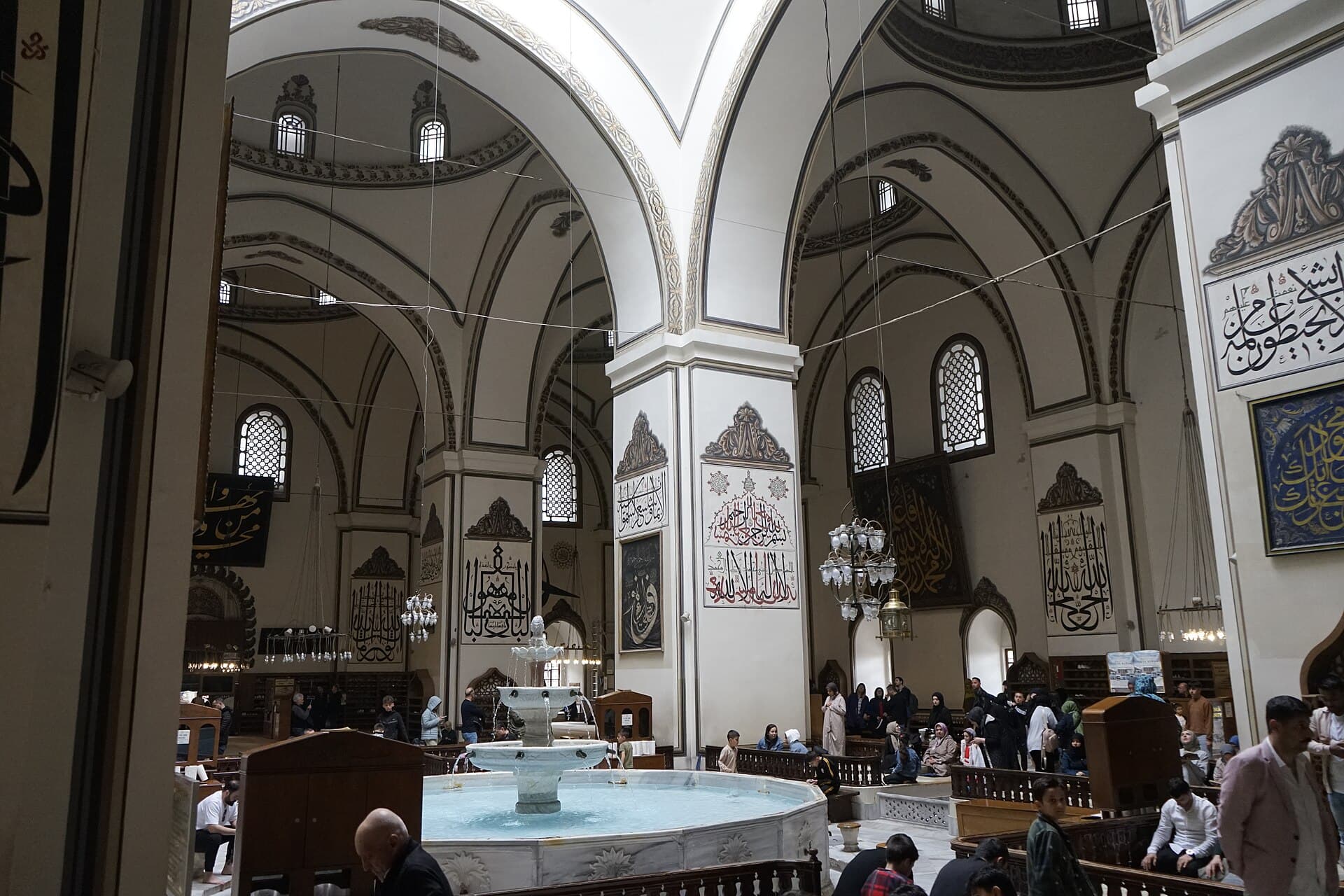
Bursa's Ulu Cami interior: the şadırvan fountain beneath its open oculus.

Twenty domes because a son-in-law talked the sultan out of building twenty separate mosques instead.

Built for Bayezid I after his victory at the Battle of Nicopolis, raised between 1396 and 1399. Tradition holds Bayezid had vowed twenty mosques in thanks for the win; his son-in-law Emir Sultan is credited with proposing one mosque with twenty domes instead. It set the template multi-domed congregational mosques across Anatolia followed for the next century.

Free — active mosque, no ticket.

30 minAn active mosque at every prayer time, not staged for visitors — expect to share the space with worshippers, and keep to the side aisles rather than the centre.The indoor şadırvan is the one truly unusual feature; miss it and you've missed the building's single best detail.The calligraphy panels are unlabelled in most languages — a guidebook or guide adds real value here that the building alone doesn't provide.
Look for: The şadırvan — an indoor ablution fountain lit by an open oculus in the central dome, almost unheard of in Ottoman design. The walls carry monumental Islamic calligraphy, added across centuries rather than in one commission.
Verified · · 4 min to Koza Han · 10 min to Tombs of Osman Gazi and Orhan Gazi
Rank2
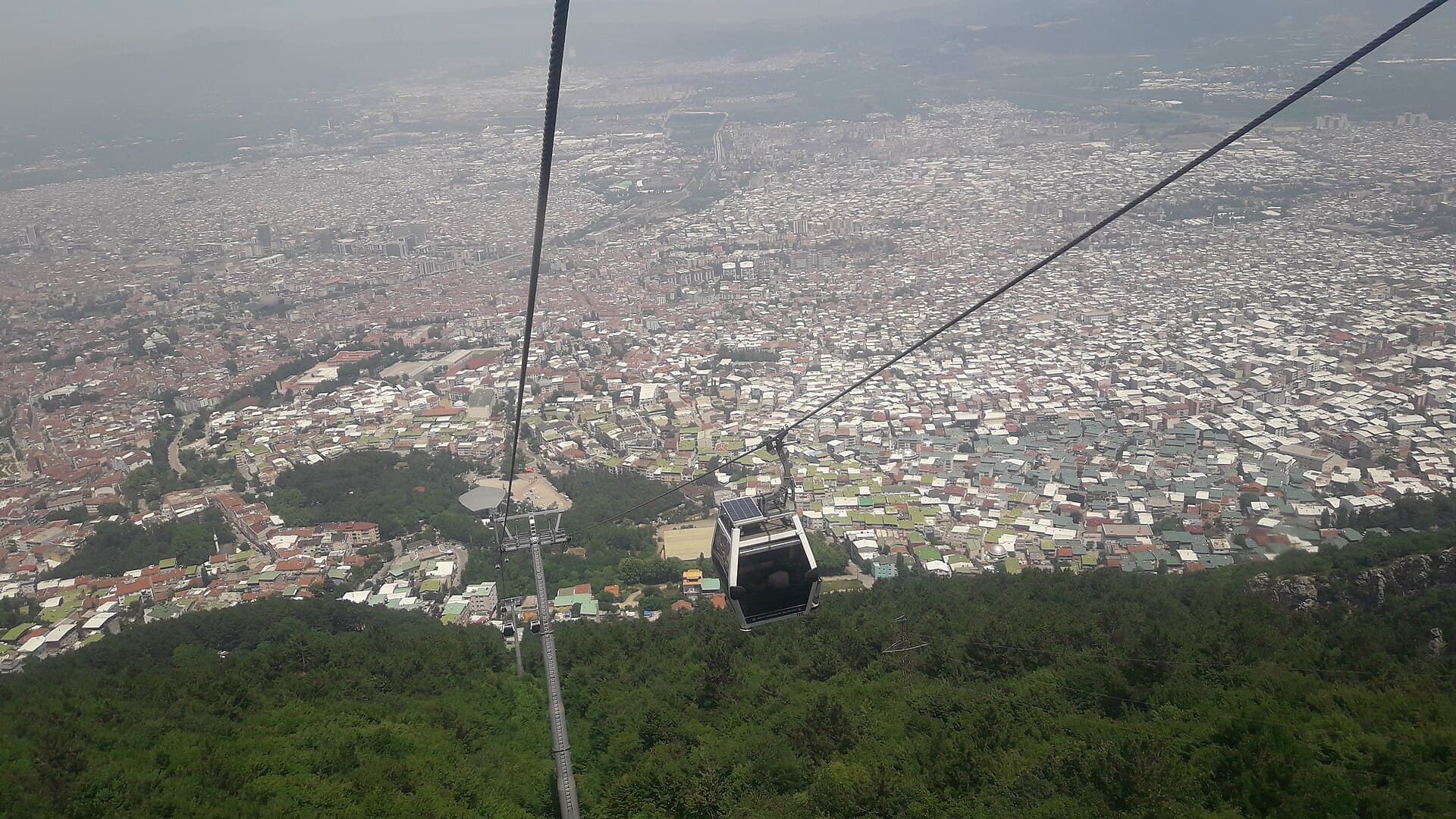
Uludağ cable car gondola cabin on the ropeway high above Bursa city.

Uludağ

Natural site

Ancient Olympos, a mountain the Byzantines covered in monasteries — now Turkey's oldest cable car and its most accessible ski slope.

Known to Strabo as Mysian Olympos, the mountain held as many as 28 Byzantine monasteries in its ravines by the 11th century, a concentration a 19th-century French traveller compared to Mount Athos. Ottomans called it Keşiş Dağı, Monk Mountain, after the conquest; monks gave way to wandering dervishes. It was renamed Uludağ, "Great Mountain," in 1925. Turkey's first cable car opened here in 1963.

Cable car reported at 500 TL full / 250 TL student round trip (2026 tariff, +25% on the prior year's 400/200 TL — KISMEN, single dated source; a much lower "38 TL" figure found elsewhere is almost certainly stale and was not used). Driving instead: separate Uludağ Milli Parkı vehicle gate fee, reported as either 180 TL or 225 TL depending on source (KISMEN) — confirm before travel either way.

240 minThe cable car is suspended in high wind several times most years, and a mechanical fault stranded passengers for about three hours in January 2026 (resolved safely, no injuries) — check current status before treating it as your only way up or down.Ski season and lowland Bursa's best visiting season are opposite: December–March is best on the mountain, worst in the old town; July–August is the reverse.The mountain road is a separate route from the cable car, with its own national park vehicle gate fee — decide which one you're taking before you leave the city; the two don't arrive at quite the same point.
Look for: The gondola runs from Teferrüç in the city, through Kadıyayla and Sarıalan, to the hotel and ski area near Kurbağakaya. In winter, pistes above roughly 1,800m; in summer, picnic meadows and short waymarked walks.
Rank3
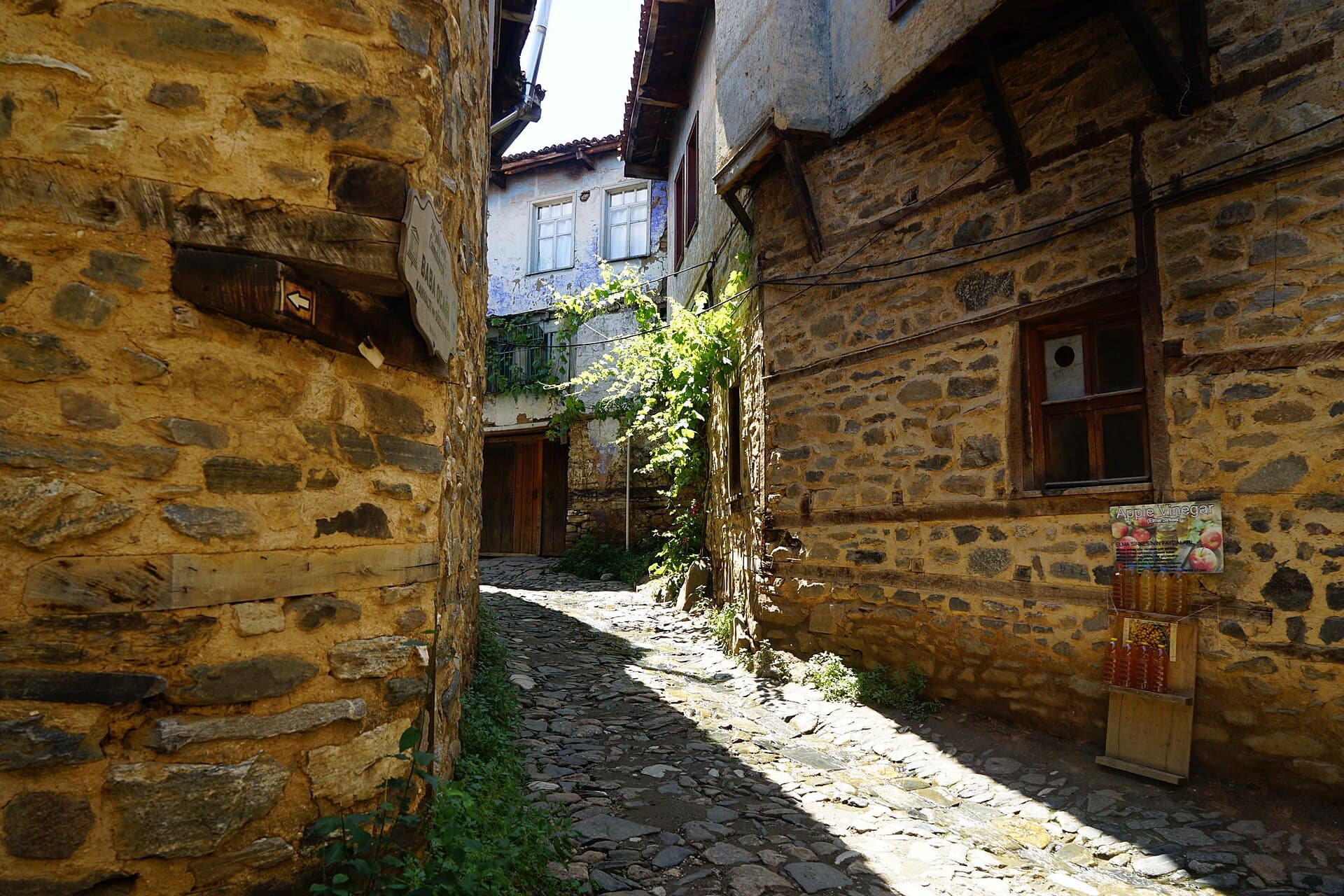
Narrow cobbled lane between timber-and-stone houses in Cumalıkızık village, Bursa.

Cumalıkızık

Neighbourhood

A working Ottoman village, not a recreation of one — houses people still live in, on a UNESCO list since 2014.

Founded around 1300 as a vakıf, an endowment village, settled under Orhan Gazi's policy of planting communities to feed and support the new capital. Its roughly 270 timber-framed houses on stone footings are among the best-preserved examples of early Ottoman rural architecture anywhere. Around 60 percent are still lived in. Listed with Bursa in 2014 as part of "Bursa and Cumalıkızık: the Birth of the Ottoman Empire."

Village entry free. Ethnography museum free, closed Mondays. Village-entrance car park reported at 5 TL (KISMEN).

120 minSteep, uneven cobbled lanes throughout — comfortable shoes matter more than the short overall distance suggests.It's a lived-in village, not a museum — stay out of open doorways and private courtyards, and treat residents' homes as homes.Weekend mornings bring a wave of Bursa breakfast day-trippers and a real parking crunch at the village entrance; afternoons are calmer, the opposite of the usual early-arrival advice.
Look for: Overhanging upper floors (cumba) over the lanes, and the free ethnography museum in a restored house, closed Mondays. Weekend mornings bring Bursa families for kahvaltı — Turkish breakfast — before the village empties by afternoon.
Rank4
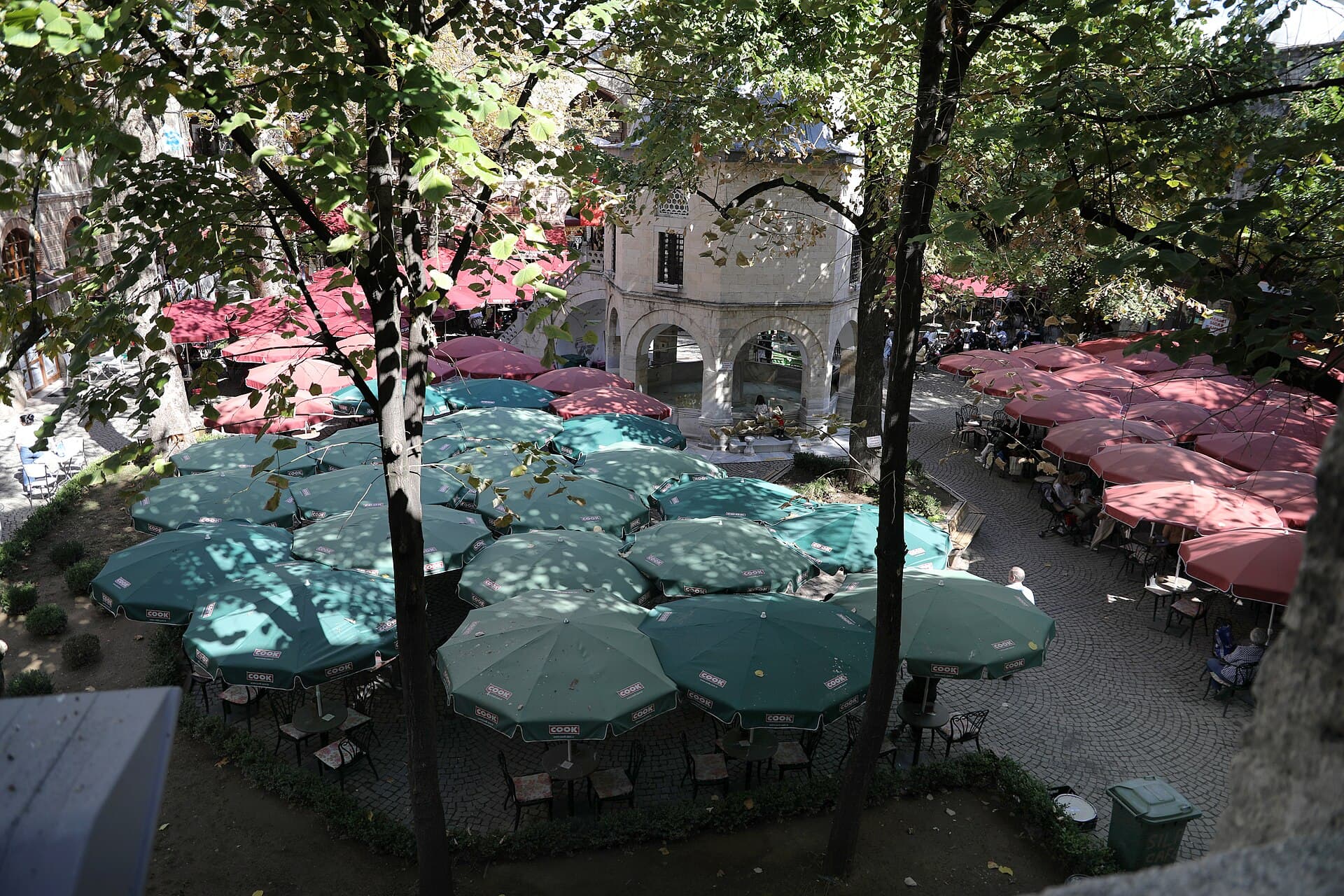
Koza Han courtyard with domed mosque, şadırvan fountain, and plane trees.

Koza Han

Market

A 1491 silk exchange that still auctions raw cocoons every June — the building that explains where the money for Bursa's mosques came from.

Built in 1491 for Bayezid II, its rents endowing his mosque complex in Istanbul, on a site between the Orhan Gazi Mosque and Ulu Cami. Two storeys of some 95 rooms around a courtyard functioned as Bursa's silk cocoon exchange — the commodity that made the city rich enough to fund its mosques, tombs and hans. A working cocoon auction is still held in the courtyard each June.

Free to browse; shops price individually, bargaining expected. Reported hours: 08:00–19:30 Mon–Fri, 08:00–20:00 Saturday, 10:30–18:30 Sunday (KISMEN — single source, but specific).

45 minMost silk and pashmina on the upper-floor stalls is imported stock, not local raw silk processed on site — "genuine Bursa silk" at a bargain price is a sales line, not a fact.Tour coaches parked near Ulu Cami next door bring groups through mid-morning to early afternoon; come earlier for a quieter courtyard.The June cocoon auction is a working agricultural market on its own schedule, not a staged tourist event — exact dates shift year to year.
Look for: The small domed mosque and şadırvan at the courtyard's centre, shaded café tables under plane trees around it. Upstairs, silk scarves, textiles and jewellery — mostly imported stock now, not the local raw silk the han was built to trade.
Verified · · 4 min to Ulu Cami (Grand Mosque) · 11 min to Tombs of Osman Gazi and Orhan Gazi
Rank5
Osman Gazi's velvet-draped sarcophagus inside his domed 1863 tomb chamber.

The graves of the two men who founded the Ottoman state — inside a rebuilt Byzantine church, because the originals didn't survive 1855.

Osman Gazi, who never lived to see Bursa fall, was buried here by his son Orhan in 1326 in a converted Byzantine structure known as the Gümüşlü Kubbe, the Silver Dome. Orhan's own tomb next door occupies the former church of a monastery documented on this hill since at least the 11th century. Fire damaged Osman's tomb in 1801; the 1855 earthquake destroyed Orhan's outright. Sultan Abdülaziz rebuilt both in 1863.

Free, open-access park and tomb chambers. No published fixed hours found; treat as a daylight-hours site.

35 minWhat stands today is Sultan Abdülaziz's 1863 reconstruction, not the medieval original — the 1855 earthquake destroyed Orhan's tomb outright and badly damaged Osman's.The ramparts and clock-tower terrace behind the tombs are the actual reason to linger; don't leave right after the two tomb chambers.A working park popular with local families and older residents in the evening — quiet is expected inside the tomb chambers themselves, less strictly on the terrace.
Look for: Osman's sarcophagus under the left dome, Orhan's under the right, a few steps apart. Behind them, Tophane's ramparts open the widest free view in Bursa, toward the 1905 clock tower and the Green Mosque hill opposite.
Verified · · 10 min to Ulu Cami (Grand Mosque) · 11 min to Koza Han
Rank6
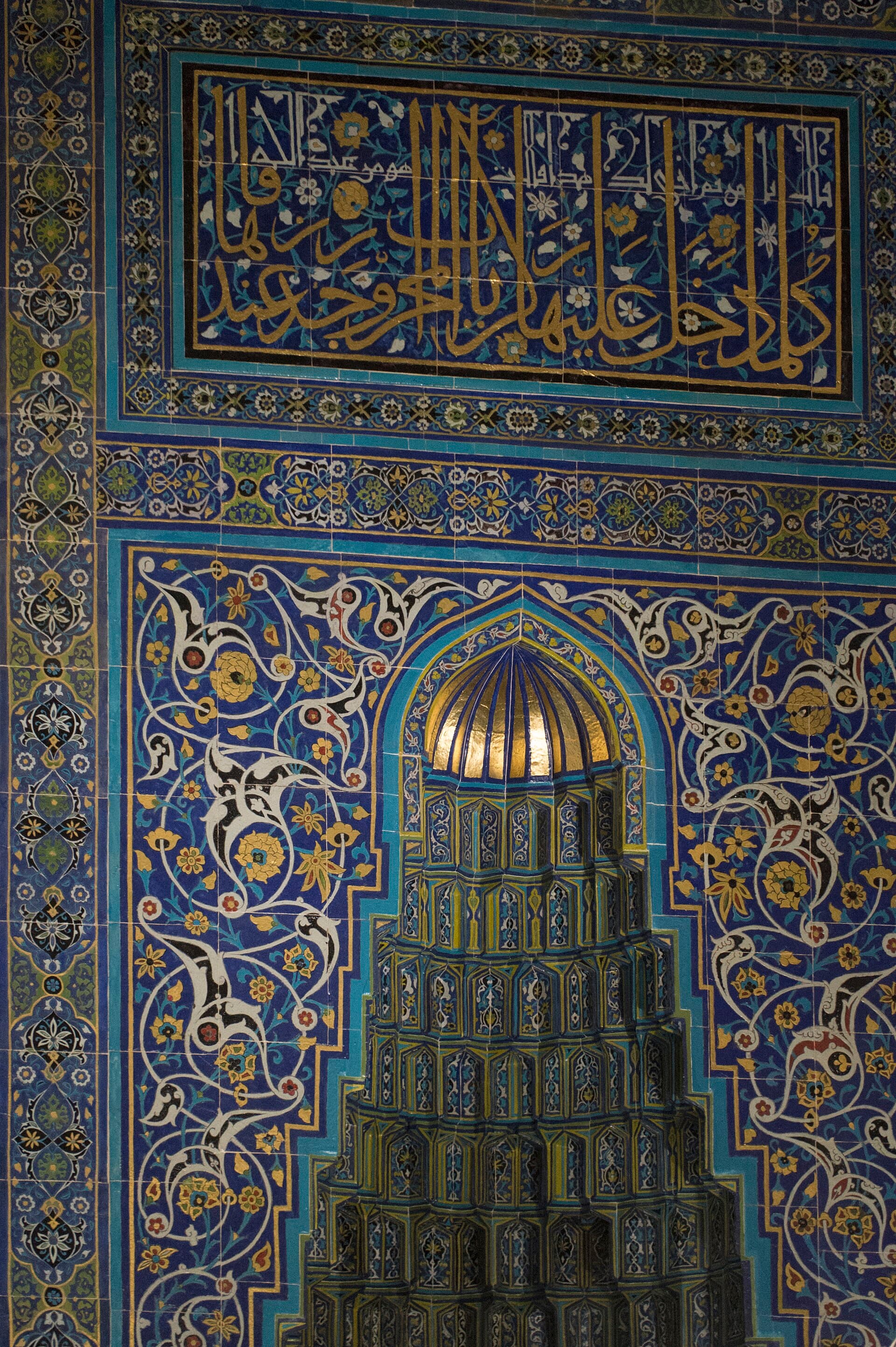
Tiled mihrab niche of the Green Mosque in Bursa, Türkiye.

The tile masterpiece of early Ottoman architecture — finished four years after the sultan who commissioned it was already dead.

Commissioned by Sultan Mehmed I after he reunified the Ottoman state following a decade-long civil war among his brothers, built from 1412 by the architect Hacı İvaz Pasha. The structure was substantially complete by 1420; the tilework, made partly by craftsmen from Tabriz, was not finished until August 1424 — three years after Mehmed died in Edirne. His tomb stands across the plaza.

Free — active mosque, no ticket. Reported open roughly 09:00–18:00 outside prayer times (KISMEN, not independently cross-verified to the minute).

30 minCloses to visitors during each of the five daily prayers and for the whole of Friday midday — a working mosque, not a museum on a fixed schedule.The sultan's loge is easy to miss — it's above and to the right of the entrance, not visible if you only look toward the mihrab.No real shade on the approach plaza; the tile glare is strongest at midday.
Look for: The sultan's tiled loge above the entrance, reserved for his prayers alone. An inscription over the mihrab credits the black-line tiles to "the masters of Tabriz" — Persian craftsmen, not İznik's later workshops.
Verified · · 15 min to Koza Han · 18 min to Ulu Cami (Grand Mosque)
Rank7
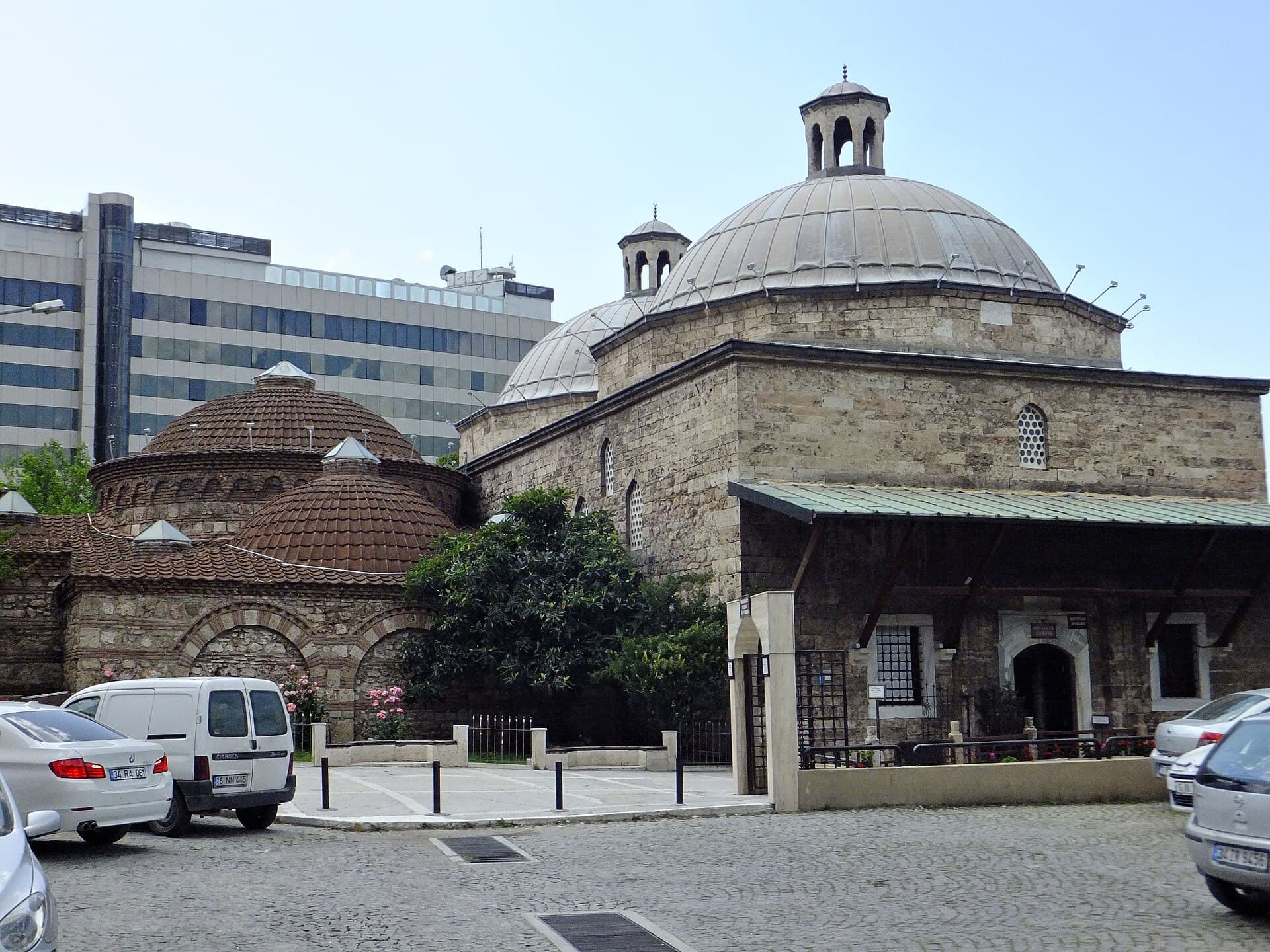
Eski Kaplıca's domed stone exterior and entrance porch in Bursa's Çekirge district.

A Byzantine empress reportedly bathed here before the Ottomans arrived — a working 44°C thermal hamam, not a spa with a borrowed history.

Thermal bathing at Çekirge, ancient Pythia, dates to at least the Roman period; Emperor Justinian built baths here in the 6th century, and legend ties the site to Empress Theodora. Rüstem Pasha, Süleyman the Magnificent's grand vizier and son-in-law, enlarged the existing bath in 1552 after the waters reportedly eased the sultan's gout. It has operated since, now attached to the Kervansaray Termal hotel.

Day-use entry price not found despite multiple searches — budget for a mid-range hamam visit and confirm on arrival. Kese (scrub) and massage charged separately from basic entry; private family section available for an extra fee.

90 minCurrent day-use entry pricing could not be confirmed independently — budget for a mid-range hamam visit and confirm the figure on arrival or by phone rather than trusting an old number online.Sections are separated by sex unless you specifically book the private family option — standard hamam practice, not unique to this one.The water emerges at 44°C — hot enough to ease into rather than commit to fully on first contact.
Look for: Eight Byzantine-era marble columns still ring the hot pool. Water emerges at 44°C, used for skin conditions and rheumatism since antiquity. Separate sections for men and women; a family/private option exists for an extra charge.

Worth your time

Worth your time

A second day earns you these.

Rank1

Green Tomb (Yeşil Türbe)

Historic site

Named for a colour it isn't quite — the tiles read turquoise, not green, and most of what you see is a 20th-century remake.

Built 1414–1421 as the tomb of Sultan Mehmed I, who commissioned the Green Mosque across the square and is buried here beneath a monumental cenotaph. The tiles that gave it its popular name are firuze, a Persian turquoise-blue rather than true green. The entrance portal was badly damaged in the 1855 earthquake, repaired in 1864 (KISMEN); a further major restoration reportedly ran 2007–2009 (KISMEN).

Free.

20 minMost of the exterior tile is 20th-century replacement work made at the Kütahya Çini Fabrikası, not the original 15th-century glazed brick — well done, but genuinely not original.A working mausoleum with a steady flow of respectful visitors reciting a short prayer at the cenotaph — quiet is expected, more so than at a typical museum stop.
Look for: The exterior tile is largely modern, replaced at the Kütahya Çini Fabrikası since reproducing the original glazed brick exactly wasn't feasible. Inside, the sultan's oversized cenotaph dominates the chamber, sheathed floor to peak in tile.
Open in Maps
Rank2

Muradiye Complex

Historic site

Twelve tombs, forty Ottoman dynasty members, one garden — the empire's second-largest royal cemetery after Istanbul.

Built by Sultan Murad II from 1425–26 as a mosque complex with bath, madrasa and soup kitchen, on a bluff meant to let the city expand outward. Twelve tombs were added over the following century, the last dating to the reign of Selim II. Murad II himself is buried in the largest, built by his son Mehmed the Conqueror after Murad's death at Edirne in 1451.

Free (KISMEN — single source, but consistent with how Turkey generally treats tomb/külliye complexes of this kind). Reported hours roughly 08:00–20:00.

40 minTwelve separate tomb buildings across a garden — pace yourself, this rewards an unhurried walk more than a checklist tour of each one.Some tombs hold murdered Ottoman princes, casualties of succession politics — a sombre layer under the pleasant garden setting, worth knowing before you go in expecting only architecture.
Look for: Murad II's tomb has an oculus left open to the sky, following his reported wish to lie under open air. Elsewhere: the tombs of Cem Sultan and several murdered şehzades (princes), a sombre record of succession politics.
Open in Maps

If you have longer

If you have longer

Keep these compact stops in mind when you build your trip.

Bursa's covered bazaar and bedesten (the fortified jewellers' hall) grew from the 14th and 15th centuries around Ulu Cami and Koza Han as the commercial core of the Ottoman capital. A fire on 24 August 1958, started by a knocked-over stove in the secondhand booksellers' section, destroyed some 1,570 shops. The rebuilt bazaar rose as a two-storey structure; the upper floor is still largely fabric and silk sellers.

Free to browse; individual shop prices vary, bargaining expected outside food stalls.

Reported closed on Sundays, consistent with Bursa's other historic bazaars — this specific detail is KISMEN, not fully cross-verified; treat Sunday as a lower-confidence day to visit.Busiest and most animated on weekday mornings and Saturdays; quieter and flatter outside those windows.
60 minOpen in Maps

Irgandı Bridge

Historic site

Built in 1442 under Murad II, financed by the silk merchant Hoca Muslihuddin and designed by Timurtaş's son Abdullah, originally carrying 32 shops in two rows over the Gökdere stream. Occupying Greek forces destroyed it by bombing in 1922 during the Turkish War of Independence. Rebuilt as bare concrete in 1949, it was restored to its arasta, shop-lined form in 2004.

Free, open public bridge.

The shops on the bridge today are 2004-restoration units, not medieval survivals — the bridge itself was destroyed by bombing in 1922 and rebuilt twice since.Easy to walk straight across without realising it's a bridge at all — the shopfronts on both sides hide the Gökdere stream below; step down to the streambank for the view that makes sense of the place.
20 minOpen in Maps

Karagöz shadow theatre traces its origin to Bursa: tradition holds its two title characters were labourers on the Orhan Gazi Mosque site, executed for joking on the job, then reanimated in silhouette by a bystander to console the sultan. The museum opened in 1997 as an arts centre, became Turkey's first dedicated Karagöz museum on 14 June 2007. UNESCO listed Karagöz as Intangible Cultural Heritage in 2009.

Free (KISMEN). Reported hours roughly 09:30–17:30.

Closed Mondays.Live shadow-play performances run on a limited schedule, not on demand — check ahead if seeing an actual performance, not just the puppets on display, matters to your visit.
40 minOpen in Maps

Getting there and away

Verified routes from Bursa.

Door-to-door times and fare ranges, checked leg by leg. Only routes where every leg verified are listed.

Getting around

Türkiye, for scale

Where it sits

See this city in the wider shape of Türkiye.

The map will load as it approaches the viewport.