TurQuosian

Aegean

Fethiye

Where the coast learns to fly

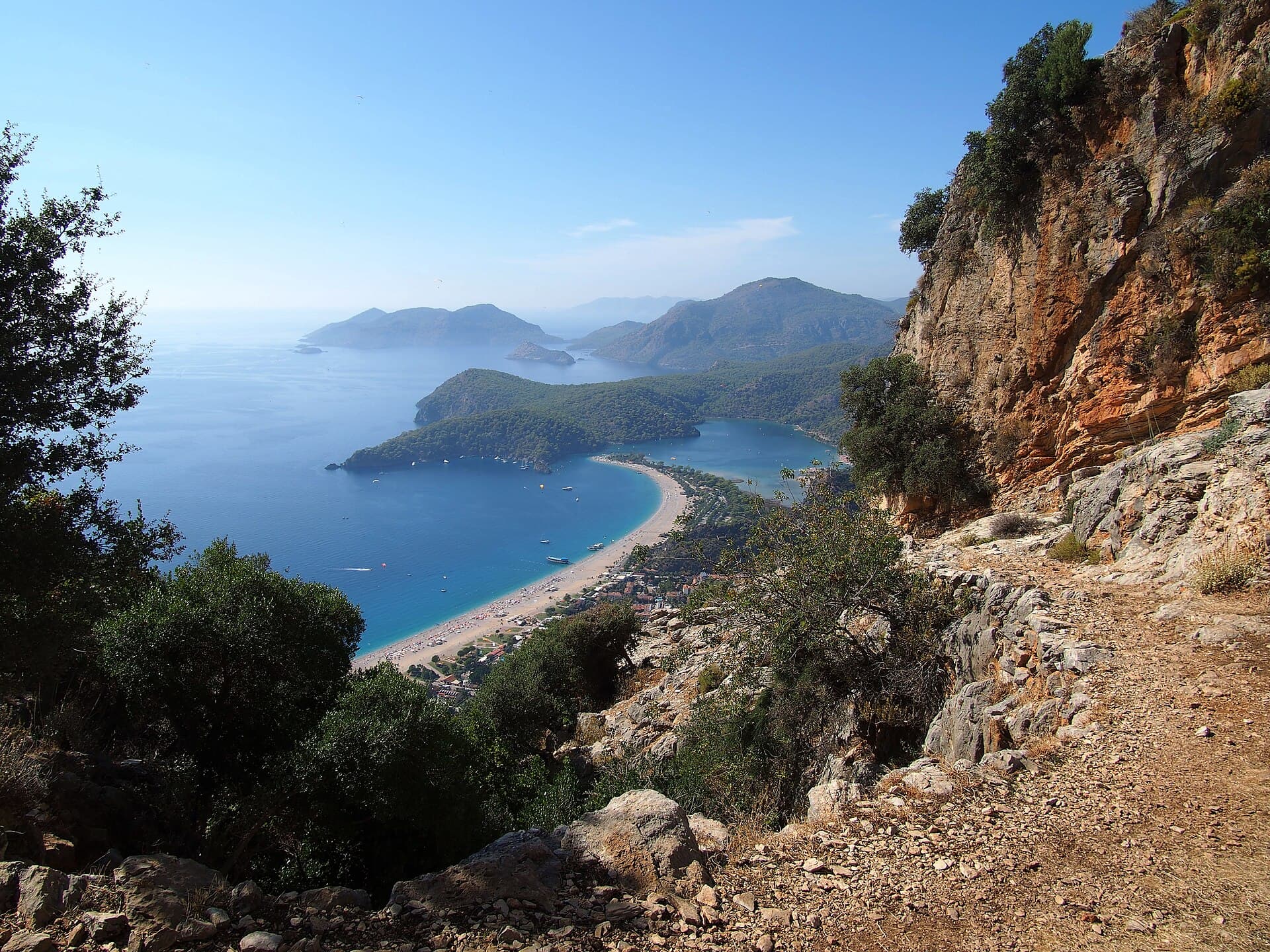
Fethiye is a working port town built over ancient Telmessos, its rock tombs cut into the cliff above the harbour. Fifteen minutes away, Ölüdeniz's lagoon and paragliders drifting down from Babadağ make one of the coast's most photographed pairings. Base here for three days: the beach and the sky, a village silenced in 1923, and a gorge and a long-distance trail running south of town.

Stay
3 days
Best months
May–Jun, Sep–Oct
Airport
Dalaman (DLM), ~45km
Headline activity
Paragliding over Ölüdeniz
Base town
Fethiye, not Ölüdeniz
Population
~187,000 (2025)

Every published place in one city guide

What to see in Fethiye.

Start with the essentials, add what genuinely interests you, and leave the rest for another visit. Every place includes a concise story, practical timing, a Maps link, and a one-tap route planner action.

Make the route work

Anticipate the practical details.

Getting there

Dalaman Airport (DLM) is the gateway, about 45km and 45–60 minutes from Fethiye by taxi or shuttle, and busy with charter and budget routes especially from the UK. There is no rail line to Fethiye. Intercity buses run to the Fethiye otogar from major Turkish cities.

Getting around

Dolmuş minibuses radiate from the Fethiye otogar to Ölüdeniz, Kayaköy, Çalış and Ovacık/Hisarönü, frequent in season. Saklıkent, Tlos and Kabak have no reliable public transport — a rental car, taxi, or organised tour is the practical option for all three, and Saklıkent and Tlos pair naturally on the same road. Fethiye town itself is compact and walkable.

Money

Turkish lira. Cards are widely accepted in Fethiye town; nature parks, dolmuş rides, market stalls and boat-trip extras often want cash. Entry fees at Ölüdeniz Nature Park, Saklıkent and Kayaköy are paid in lira at the gate.

Connectivity

eSIM or a local SIM works well in Fethiye town, Ölüdeniz and along the main coast roads. Coverage is patchy inside Saklıkent Gorge, around Kabak, and on boat trips further from shore.

Etiquette

Kayaköy is a preserved heritage and memorial site, not a ruin to scramble over — don't remove stones or climb the unstable walls. Standard mosque etiquette applies if visiting one. It is normal, not rude, to ask a paragliding operator directly about their and their pilot's current licensing before booking.

Safety and comfort

Paragliding carries a real, government-flagged risk of serious injury or death — see the paragliding entry above for specifics, and choose an operator deliberately rather than by price alone. Sea conditions in Ölüdeniz's lagoon are calm; the open sea side and boat-trip waters carry more current. Türkiye is seismically active — Fethiye itself was largely destroyed by a 7.1–7.3 magnitude earthquake in 1957 — and ordinary earthquake awareness applies as anywhere in the country.

Where to stay

Pick the area first.

The property is your call — the area decides how the trip feels. Each card says why, who it suits, and the thing a booking site won't tell you.

Fethiye centre & Paspatur

First visit

The old-town bazaar, fish market, marina and Lycian rock tombs are all walkable, with dolmuş and boat links to every beach in the gulf.

First visit, food and markets, boat trips

Worth knowing: There is no beach in town — the nearest swimming is Çalış or a boat away — and the centre is a working town, not a resort.

Ölüdeniz

You wake up next to the Blue Lagoon and Belcekız beach, with paragliders landing on the promenade and the Lycian Way starting nearby.

Beach-first stays, paragliding

Worth knowing: It is the priciest, most package-resort corner of the gulf, largely shuts down in winter, and Fethiye town is 20–30 minutes away by dolmuş.

Çalış Beach

A long, flat beachfront promenade with famous sunsets, cheaper rooms than Ölüdeniz, and a water taxi or dolmuş into Fethiye town.

Budget beach stays, families, longer stays

Worth knowing: The beach is coarse shingle rather than lagoon sand, the strip leans towards British-expat bars, and it goes quiet out of season.

Hisarönü & Ovacık

A hillside base between Fethiye and Ölüdeniz where paragliding operators and Lycian Way walkers cluster, minutes from the lagoon by dolmuş.

Paragliders, hikers, lively bars on a budget

Worth knowing: The resort strip is loud, unashamedly built for package tourism, and you still need transport to any actual beach.
Essential

Don’t leave without

If you only have one day, this is the day.

Rank1
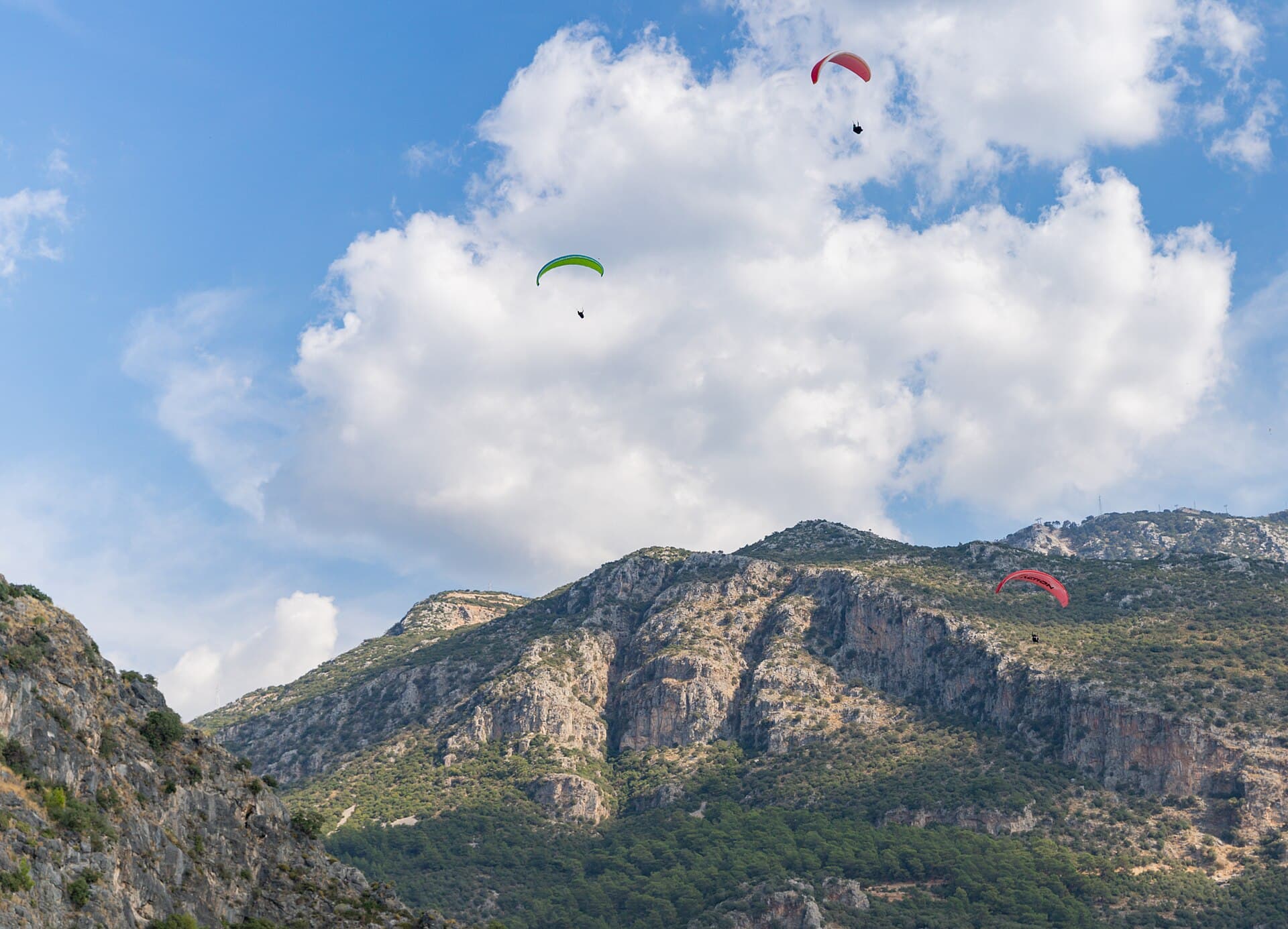
Colorful paragliders drift above Babadağ's cliffs over Ölüdeniz, Türkiye.

The world's highest tandem paragliding site — a ridge above 1,900m onto a lagoon — and where this coast's safety risk concentrates.

Ölüdeniz's sheltered bay and the ridge above it, Babadağ, made this the coast's paragliding capital; operators fly tandem passengers off the summit most days from April into late autumn. Türkiye's civil aviation authority licenses pilots and operators. A cable car now reaches most of the way up for visitors who want the view without flying.

Tandem flights commonly quoted €90–180 (2026 operator listings), varying by season and extras (video/photos often +€30–40) — get the exact price in writing before paying. Cable car (for non-flyers) 890 TL per person, free under 7, 660 TL students/disabled (quoted June 2026).

150 minParagliding is an extreme sport with a real, documented risk of serious injury or death — stated directly by the UK government's Türkiye travel advice, not just this guide's own caution.In April 2025 a tandem pilot and passenger died in a parachute-failure crash on Babadağ; flights were briefly suspended and an investigation opened. Ask specifically about your pilot's and operator's current licensing before booking.Flights are weather-dependent and cancellations happen; confirm your operator's refund/rebooking policy before paying, especially on a short stay.
+1 more to know
A 15-year-old British tourist was struck by an out-of-control paraglider while eating at a beachfront restaurant in November 2024. If you are not flying, keep well clear of marked landing areas, especially at Belcekız Beach.
Look for: Chase vehicles on the dirt roads below, tracking pilots toward Belcekız Beach — the landing point, not the lagoon itself. The cable car for non-flyers. Ask whether your pilot and operator hold current SHGM licensing before you book.
Rank2
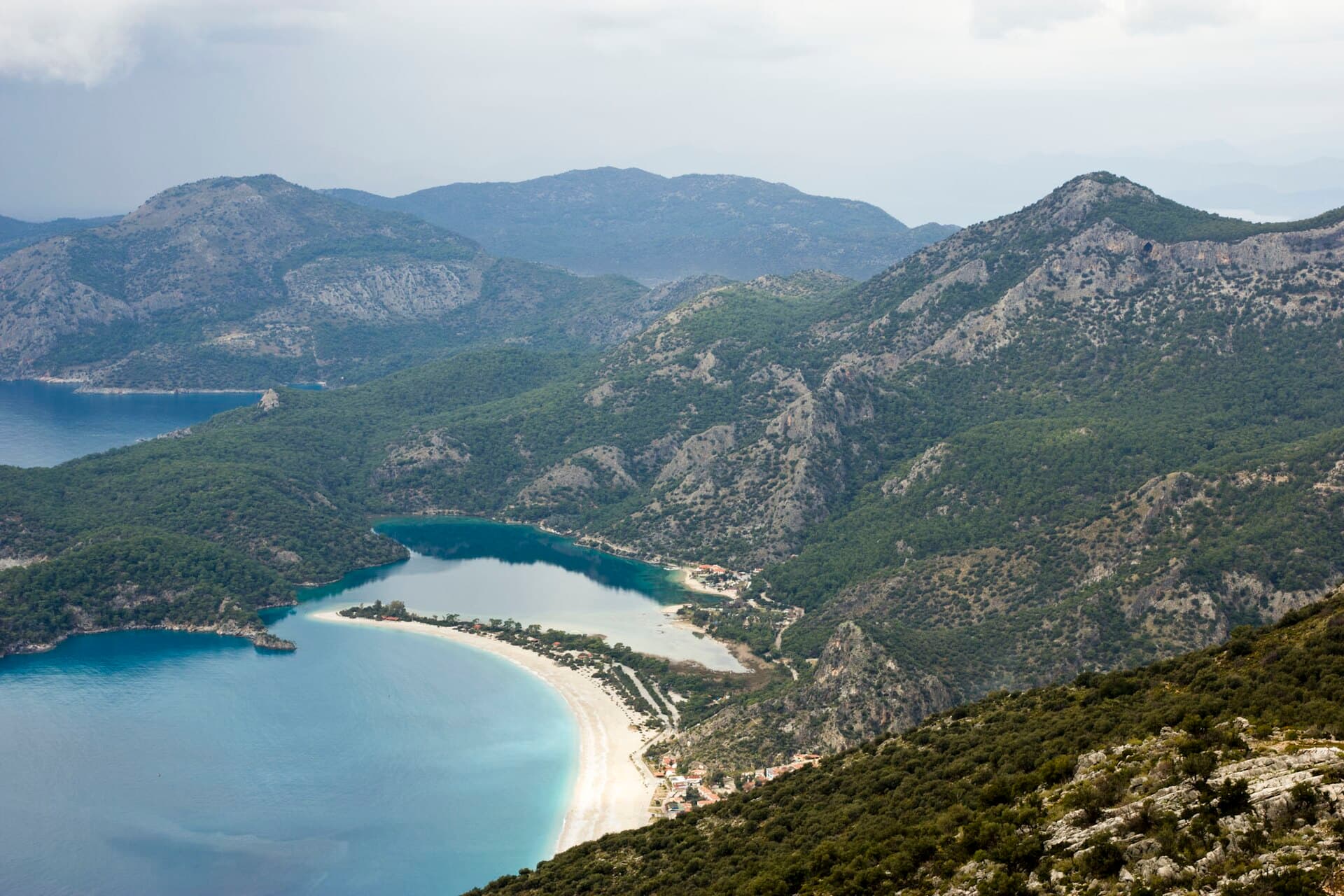
Aerial view of Ölüdeniz's turquoise lagoon enclosed by a narrow sandy spit.

Two beaches share one name: Belcekız, open and free, where paragliders land, and the lagoon proper, gated and ticketed, a short walk south.

"Ölüdeniz" — "dead sea" — names the near-landlocked lagoon at Kumburnu, sealed from the open bay by a sand spit and calm enough that storms barely move it. Protected as a nature park with construction banned inside, it is a Blue Flag beach and one of the most photographed coastal views in Türkiye.

Ölüdeniz Nature Park (the lagoon): 150 TL pedestrian, 800 TL per vehicle (covers all passengers), 450 TL motorbike — quoted for August 2026. Belcekız Beach itself is free and unticketed.

180 minThe lagoon (Kumburnu, ticketed) and Belcekız Beach (free, open sea) are two different places a short walk apart — check which one your hotel or transfer actually drops you at.No motorised watercraft inside the lagoon; the open sea side has more current and boat traffic than the sheltered lagoon water.Extremely crowded at midday in July and August. Early morning or the last two hours before closing are the workable windows.
+1 more to know
Paragliders land on Belcekız Beach, not in the lagoon — stand well clear of the marked landing strip if you are not flying.
Look for: The classic view from the Ovacık road on the way down to the bay. Inside the park: pedalo and paddleboard hire at Kumburnu, no motorised craft permitted. Outside it, on Belcekız: paragliders landing through the afternoon.
Rank3
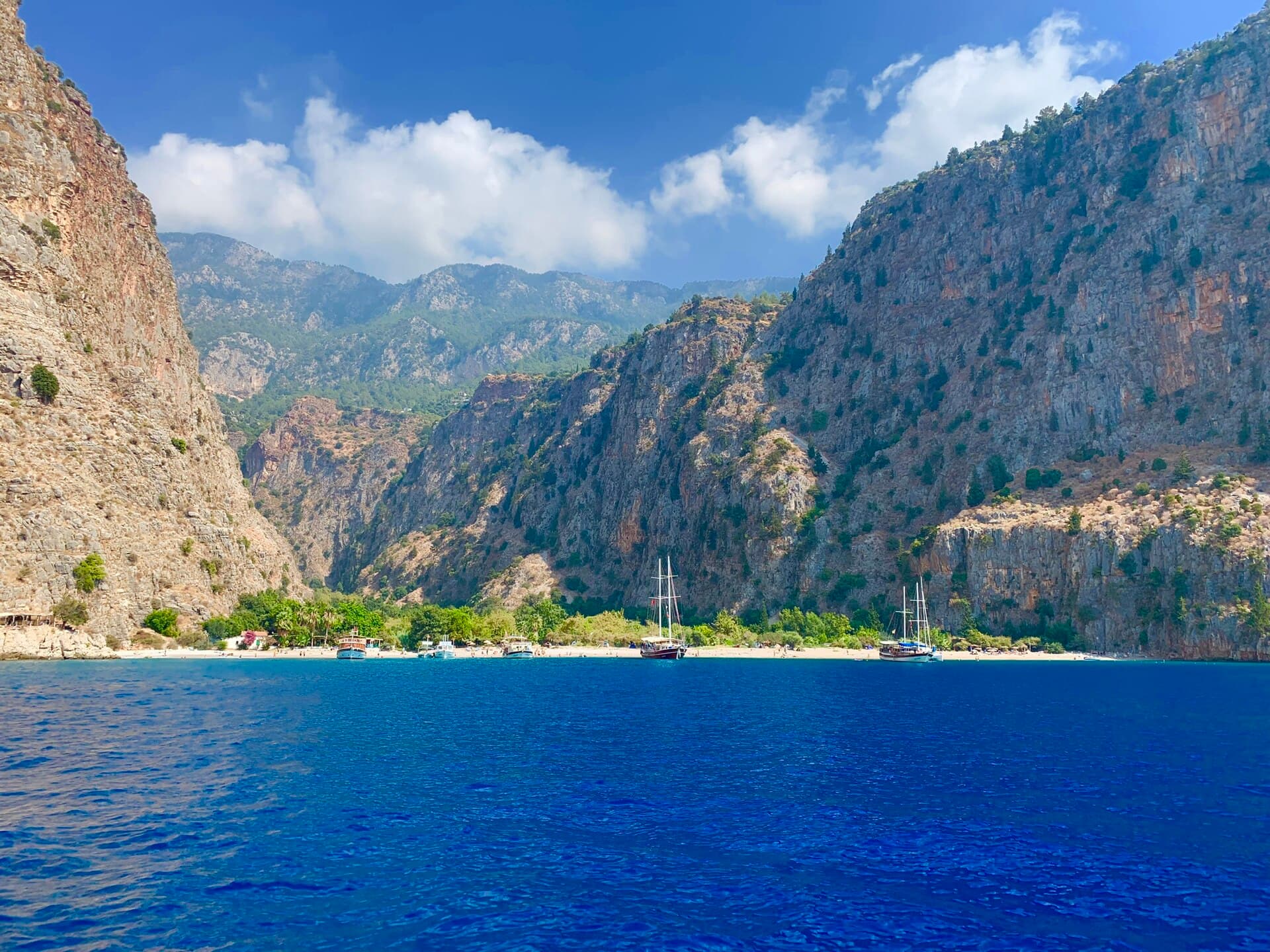
Elevated view of Butterfly Valley's steep cliffs and secluded beach near Fethiye

Named for a day-flying moth, not a butterfly, in a valley whose cliff path has become too dangerous to recommend. Go by boat.

Jersey tiger moths cluster here by the thousand each summer, giving the valley its name. The clifftop path from Faralya is a steep, unmaintained scramble that has repeatedly injured hikers and was closed again by rockfall in May 2025; boats from Ölüdeniz are now the standard and reliable access.

Return shuttle boat from Ölüdeniz (Belcekız Beach ticket booth): around 500 TL per person (quoted August 2026), cash or card.

120 minThe Faralya cliff path is not a recommended casual hike — it is steep, loose and rope-assisted in places, has injured hikers, and was closed by rockfall again in May 2025. Go by boat.Boats run to a fixed schedule with a limited number of return sailings. Confirm the last return time and be at the beach well before it — there is no guaranteed later crossing.Minimal shade and no permanent facilities beyond seasonal drink stalls; bring your own water.
Look for: Scarlet underwings flashing as the moths lift off in numbers, July into September. A short walk inland reaches a small waterfall — tight to combine with swimming inside a single boat stop.
Rank4
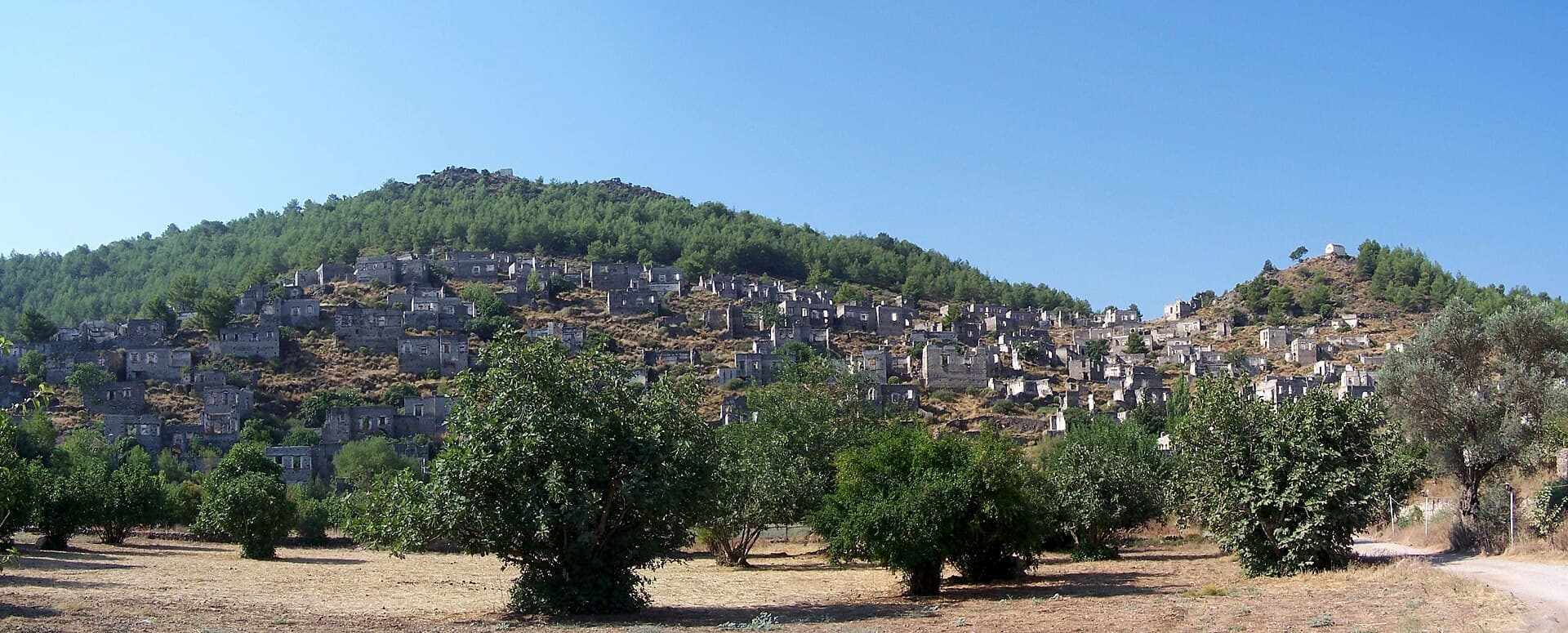
Panoramic hillside view of Kayaköy's hundreds of abandoned roofless stone houses.

Kayaköy

Historic site

A Greek hillside town emptied by the 1923 exchange, finished off by the 1957 earthquake. Roughly 500 stone shells, still standing empty.

Levissi held over 6,000 Greek Orthodox residents until the 1923 population exchange sent them to Greece; Muslim resettlers arriving from Greece found the terrain poorly suited to their farming and mostly left within years. The 1957 earthquake that flattened much of Fethiye brought down more of the already-empty houses. Now protected as a heritage and "peace village" site.

Around 100–120 TL (2026 season; sources vary).

90 minNo shade anywhere on site. Visit in the morning or the last two hours before closing in summer.Uneven ground, loose rubble and broken thresholds throughout — footwear matters here.Do not climb the ruined walls for photographs; they are unreinforced and unstable, not a viewing platform, whatever the well-worn paths up them suggest.
Look for: Two roofless churches with surviving frescoed plaster and marble floor fragments. The disciplined rows of stone houses climbing the hillside, and the outline of cisterns, ovens and a schoolhouse among them.

Worth your time

Worth your time

A second day earns you these.

Rank1
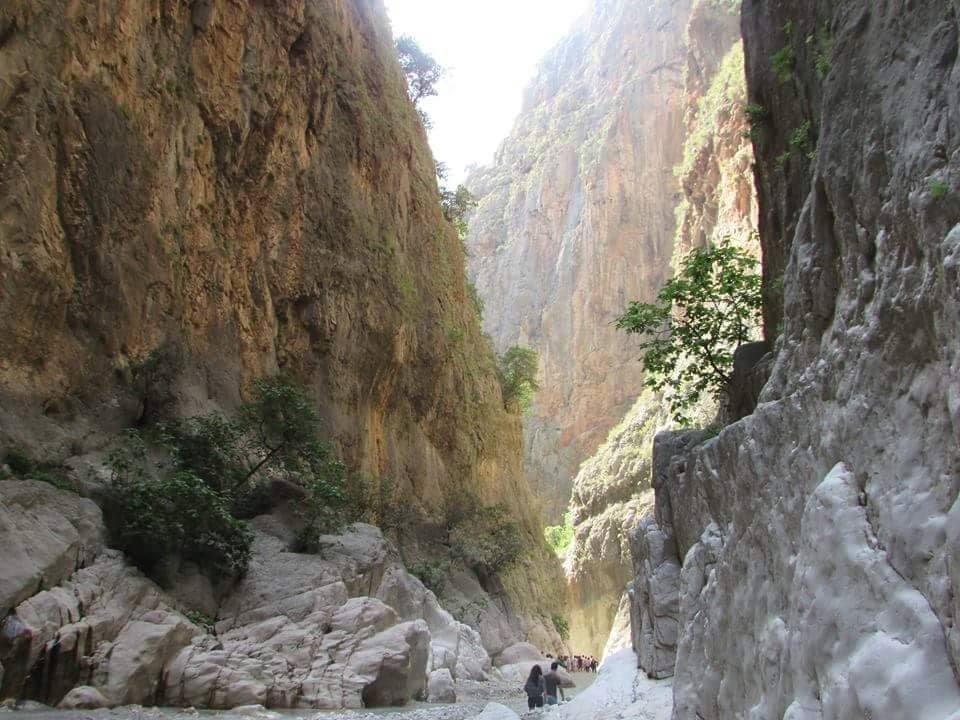
Hikers dwarfed by Saklıkent Gorge's sheer, narrow limestone canyon walls.

Saklıkent Gorge

Natural site

An 18km, 300m-deep fault-line gorge — but the real visit is the first kilometre: a walkway bolted to the cliff above glacial meltwater.

Cut by the Eşen River and its Kocaçay tributary through the Akdağlar range, ranked among the world's longer and deeper gorges. A wooden walkway carries visitors above the water from the entrance; restaurants on stilted platforms serve gözleme over the current. The maintained stretch runs roughly April to September.

250 TL adult, 125 TL student with valid ID (2026 season tariff), payable at the entrance in cash or by card.

120 minBeyond the fixed walkway, the canyon requires wading over slippery rock; a guide and rented water shoes are strongly worth it past the first stretch.Water is glacially cold year-round — a real shock in summer heat, and worth knowing before you plan on a long swim.Effectively a seasonal site: the walkway runs roughly April to September, and water levels/access can change after rain with no fixed schedule.
Look for: The walkway's drop to the rushing water below, and the cold — a genuine shock in August heat. Past its end, wading into the narrower canyon needs water shoes and, beyond the first stretch, a guide.
Rank2
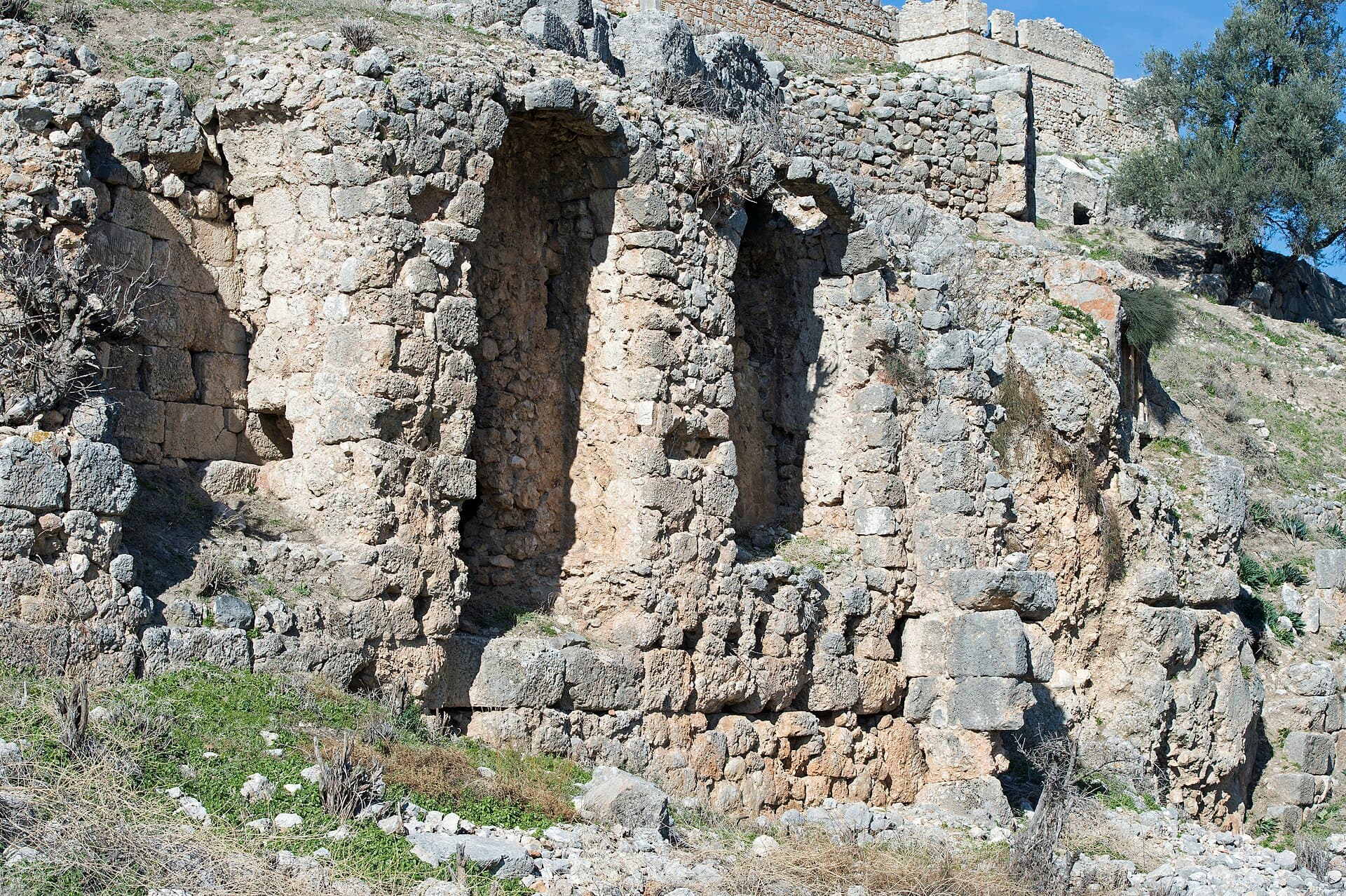
Ottoman-era fortress ruins crown the ancient Lycian acropolis hill at Tlos.

Tlos

Ancient city

A Lycian and Roman acropolis with an Ottoman warlord's fortress built on top of it, and Bellerophon's tomb cut into the cliff below.

One of six cities with three votes in the Lycian Federation's assembly. In the early 19th century, regional strongman Kanlı Ali Ağa ("Bloody Ali") built a fortress on the acropolis using the Lycian and Roman walls as its base. Below it, a temple-tomb carries a relief of Bellerophon riding Pegasus, the city's legendary founder.

Roughly 90–120 TL (2025/2026 estimates; sources vary).

120 minThe acropolis climb and rock-tomb areas involve uneven, unfenced ground with real drops in places.No public transport reaches Tlos — car, taxi or an organised tour only. Commonly paired with Saklıkent Gorge on the same road.Fully exposed with no meaningful shade; go in the morning, particularly if also visiting Saklıkent the same day.
Look for: The unfinished four-column tomb facade with Bellerophon and Pegasus in relief. Ottoman battlements sitting directly on Lycian stonework at the summit. A 150m stadium and a theatre with a three-storey stage wall on the lower slopes.
Rank3
The Lycian Way coastal hiking trail near Fethiye, Turkey, overlooking the sea.

The Lycian Way

Experience

Türkiye's first waymarked long trail starts 15 minutes from Fethiye. You're not walking to Antalya — pick one half-day stretch instead.

Kate Clow researched and waymarked the roughly 540km route from 1999, in the red-and-white stripes of European GR trails, from Ovacık near Fethiye to Geyikbayırı near Antalya. Signage is volunteer-maintained and patchy in places; the Culture Routes Society agreed to renew it with Antalya's tourism authority in 2022.

Free; no ticket or booking for the trail itself. Guidebooks and GPX tracks are sold separately by the Culture Routes Society.

240 minThis is mountain hiking terrain by the trail's own difficulty rating, not a casual coastal stroll, even on short sections. Carry more water than feels necessary.Waymarking is volunteer-maintained and has gone missing for a season at a time in places. Carry an offline map or GPX track rather than relying on paint alone.The Faralya–Kabak stretch is exposed with little shade; avoid starting in the heat of the day.
Look for: The waymarked start at Ovacık's muhtarlık. Two manageable tastes: Ovacık to Kayaköy, short and shaded; Faralya to Kabak, exposed and dramatic, ending at the beach.
Rank4
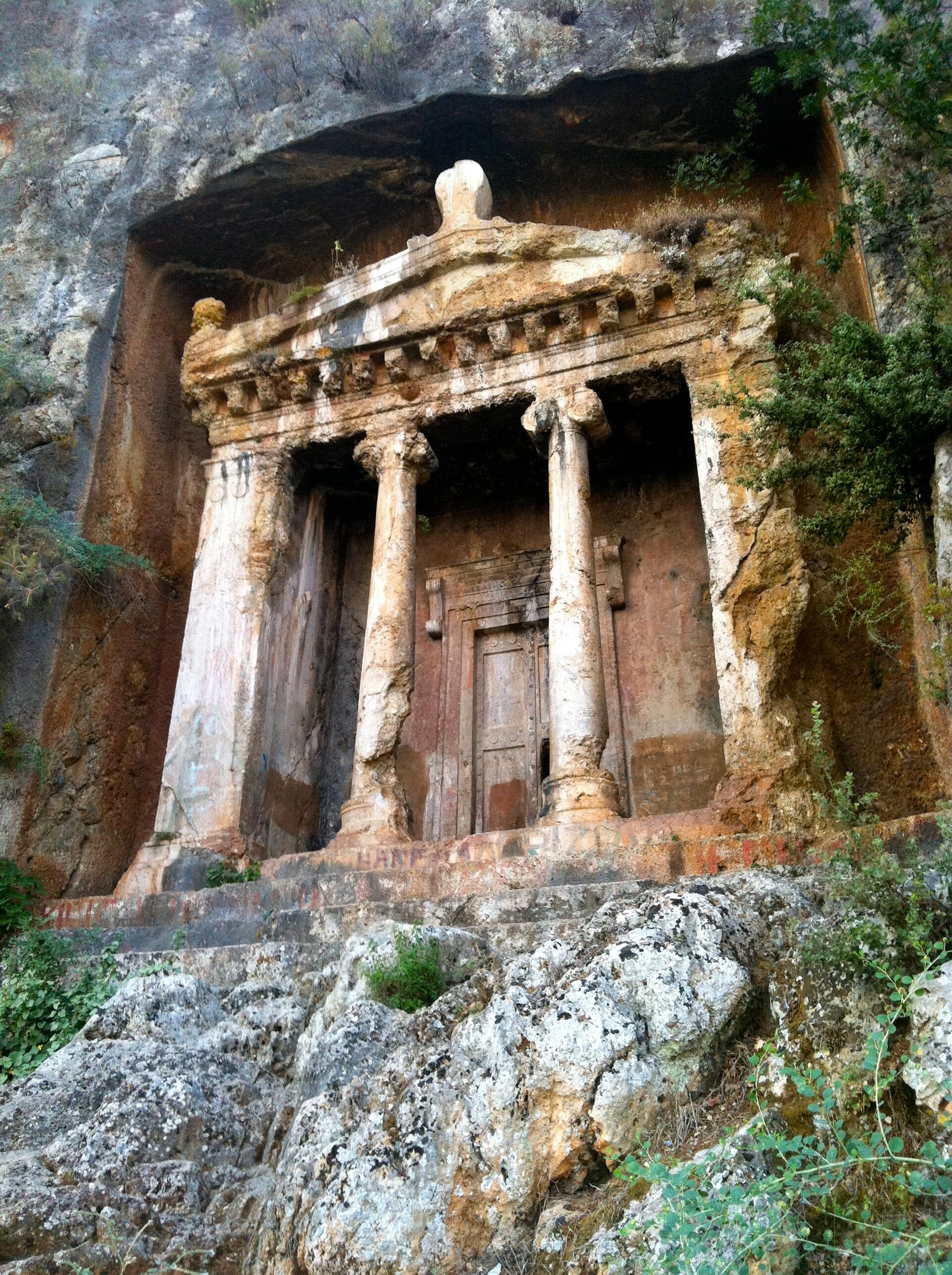
Ionic rock-cut facade of the Tomb of Amyntas above Fethiye.

Tomb of Amyntas

Archaeological site

The largest, best-preserved Lycian rock tomb on this coast — a temple front cut into the cliff, named by the inscription beside its door.

Cut around 350 BC into the hillside above ancient Telmessos as an Ionic temple facade, with a Greek inscription naming "Amyntas, son of Hermagios" beside the doorway. It is one of several rock tombs on the same slope, the only one built to full temple scale rather than a plain house-front.

Small ticketed entrance fee — current price not independently confirmed; do not treat any online figure as reliable without checking on arrival.

30 minA genuine uphill climb on stone steps from the old town — moderate but real, and fully exposed to the sun.No shade on the ascent or at the tomb itself. Carry water and go in the late afternoon rather than midday.Several other, plainer rock tombs sit on the same hillside — Amyntas is specifically the one with the full temple-style columned facade.
Look for: The two-column pediment and carved door, false-fronted with no chamber structure behind the facade. From the platform below it, the best framed view of Fethiye harbour and the bay's islands.

If you have longer

If you have longer

Keep these compact stops in mind when you build your trip.

A Byzantine pilgrimage complex of the 4th to 6th centuries, with five excavated churches, cisterns, tombs and a long covered processional walkway. Some scholars connect it to the historical Bishop Nicholas of Myra, proposing his remains rested here before later moving to Demre. Now managed as an open-air museum.

Sources suggest roughly 450–600 TL per person (2026) — this figure is notably higher than comparable regional sites; confirm at the jetty ticket booth rather than relying on it.

Reachable only by boat — private hire, an organised tour, or a water taxi from Gemiler Beach. There is no land access.Terrain is uneven rock underfoot; the upper churches need a scramble beyond the lower ruins.Often sold as a sunset add-on to a longer boat trip — confirm whether your ticket includes the island entrance fee or only the boat crossing.
90 minOpen in Maps

Opened in 1987 in two halls, archaeology and ethnography, with finds from Fethiye and the surrounding Lycian region spanning the third millennium BC to the Byzantine era. Its key holding is the Letoon trilingual stele, found at the Letoon sanctuary near Xanthos in 1973 and dated to around 337 BC, inscribed in Lycian, Greek and Aramaic.

Hours and any weekly closure were not independently confirmed for this file; confirm before a special trip.A small, quick visit rather than a half-day museum — combine it with a walk through the old town rather than building a morning around it alone.
45 minOpen in Maps

The fish market sits at the edge of Paspatur, the old town's lane network rebuilt after the 1957 earthquake around its original layout, and includes Fethiye's working harbour and small marina. Fishmongers sell the day's catch by weight; surrounding restaurants charge a table and cooking fee to grill, fry or bake it to order.

You pay the market rate for the fish, plus a separate cooking/table charge at the restaurant — get both prices before committing, not after the fish is already on the grill.

Some fishmongers steer buyers toward a particular restaurant. You're free to choose any of them — cooking charges are broadly similar across the row.Confirm the weight and price of your fish before it leaves the counter; disputes are hard to resolve afterward.
90 minOpen in Maps

The classic Fethiye day-boat format: a wooden gulet circuit calling at a rotating set of swimming coves and small islands in the bay, with lunch cooked on board. Commonly named stops include Göcek Island, Katrancı and Kızıl Ada (Red Island), though the exact route is set by each operator and the weather on the day.

Around €30 for adults, roughly half for children aged 3–6 (2026 operator listings); lunch typically included — confirm exactly what's covered before booking.

Itinerary and stops vary significantly by operator and by conditions on the day — treat any named list of islands as indicative, not a guarantee.6 to 8 hours on a boat with sun exposure for most of it; bring more sun protection than feels necessary.Pickup points span Fethiye, Ölüdeniz, Çalış, Ovacık and Hisarönü — confirm your exact pickup location and time the night before.
420 minOpen in Maps

Kabak grew from hikers on the Lycian Way rather than from resort development: a beach reached only on foot, ringed by camps offering bungalows, tents and treehouse-style platforms rather than hotels. It kept the coastline's most "off-grid" reputation as neighbouring bays built up.

Free beach access; camps charge for accommodation and sunbeds. Dolmuş run from Fethiye otogar to Kabak village, then the footpath.

No road reaches the beach itself — everyone, including overnight guests with luggage, walks down and back up a steep path.Mobile coverage and facilities are minimal by design; this is the point for most visitors, but plan accordingly.
180 minOpen in Maps

Telmessos Theatre

Archaeological site

Cut into the hillside in the Hellenistic period, 4th to 3rd century BC, and enlarged under Rome to around 28 rows seating some 6,000. Restoration work has run for an extended period, and visitor access to the seating has been limited for most of that time, with no confirmed completion date.

Free, where accessible.

Restoration has restricted interior and seating access for an extended period; confirm current status on arrival rather than assuming a standard "open" listing holds.Treat this as a short exterior stop, not a sit-in-the-seats visit, until restoration is confirmed complete.
20 minOpen in Maps

Developed through the 2000s as Fethiye's in-town beach alternative to Ölüdeniz: a long, shallow, west-facing strand backed by a promenade of cafes and small hotels that grew to serve a quieter, longer-staying crowd than the Ölüdeniz strip.

Free public beach; sunbeds and umbrellas payable in lira at hotel-front sections.

The water shelves very gradually, so reaching swimming depth means a longer wade than at Ölüdeniz.Busy and built-up along the central promenade in peak season; quieter toward the northern end.
120 minOpen in Maps

A weekly market serving Fethiye and surrounding villages, running every Tuesday with produce arriving from the Eşen plain and the hills around Kayaköy alongside household goods and textiles. It functions as a genuine local institution rather than a curated visitor experience.

Free to enter; small-note cash expected at stalls.

Tuesdays only, and largely finished by early-to-mid afternoon — there is very little to see outside that window.Minimal English is spoken; this is a working local market, not a tourist-facing one.
90 minOpen in Maps

Getting there and away

Verified routes from Fethiye.

Door-to-door times and fare ranges, checked leg by leg. Only routes where every leg verified are listed.

Getting around

Türkiye, for scale

Where it sits

See this city in the wider shape of Türkiye.

The map will load as it approaches the viewport.