TurQuosian

Aegean

Marmaris

A gulet harbour with a peninsula beyond

Marmaris is a large package-resort town, built up fast after the 1980s boom, with a town beach that isn't the draw. The real reasons to come leave from its harbour: multi-day gulet cruises in both directions, and a peninsula road running west to laid-back Datça and remote Knidos. East along the coast, the river town of Dalyan adds rock-cut tombs and a turtle-nesting beach reached only by boat.

Stay
3 days
Best months
May–Jun, Sep–Oct
Airport
DLM

Every published place in one city guide

What to see in Marmaris.

Start with the essentials, add what genuinely interests you, and leave the rest for another visit. Every place includes a concise story, practical timing, a Maps link, and a one-tap route planner action.

Make the route work

Anticipate the practical details.

Getting there

Dalaman Airport (DLM) is the gateway, roughly 95km / 1h20–1h30 by road on the D400 coastal highway (transfer, shuttle or taxi) — most summer charter flights from the UK and Western Europe land here. There's no useful rail option. For the Datça side, a car ferry also runs from Bodrum (Bodrum–Datça, about 105 minutes, up to four sailings a day at peak summer) — a genuine alternative to driving around the gulf if you're coming from that direction.

Getting around

Marmaris, İçmeler and Turunç are linked by frequent dolmuş along the coast road. Datça is a further ~71km / about an hour west on a good but winding road; Knidos is another 35km / 45–60 minutes beyond Datça town, the final stretch narrow — treat it as a Datça overnight rather than a single Marmaris mega-day, or take a gulet that calls there by sea. Dalyan is roughly 1h15–1h30 east; direct dolmuş from Marmaris is limited, and most public transport connections change at Ortaca. Inside Dalyan, boats — not roads — reach Kaunos, İztuzu Beach and the mud baths.

Money

Turkish lira is standard everywhere and cards are widely accepted in Marmaris and Datça; carry cash for Dalyan's river-boat cooperative, mud-bath entry and rural stalls. State-run sites (Knidos, Kaunos, Marmaris Museum) price foreign visitors in euros, but the gate takes lira or card.

Connectivity

Strong 4G/5G across Marmaris, İçmeler, Datça and Dalyan town. It thins on the open peninsula road out to Knidos and drops out for stretches on the water — download offline maps before the Datça–Knidos drive or a Dalyan river trip.

Etiquette

Beachwear stays on the beach — cover up for the bazaar, the museum, and any village restaurant on the Datça road. On İztuzu Beach in nesting season (May–October), keep well behind the marked stake lines protecting turtle nests, and don't use flash photography or lights on the sand after dark.

Safety and comfort

A well-touristed, low-risk coast; the real hazards are sun, heat and boat traffic. Knidos and Kaunos have little shade at midday in July–August — carry water and start early. Around the İztuzu/Dalyan delta, speedboats are barred within a mile of the beach specifically to protect swimmers and nesting turtles — a sign of active patrolling, not a reason for concern.

Essential

Don’t leave without

If you only have one day, this is the day.

Rank1
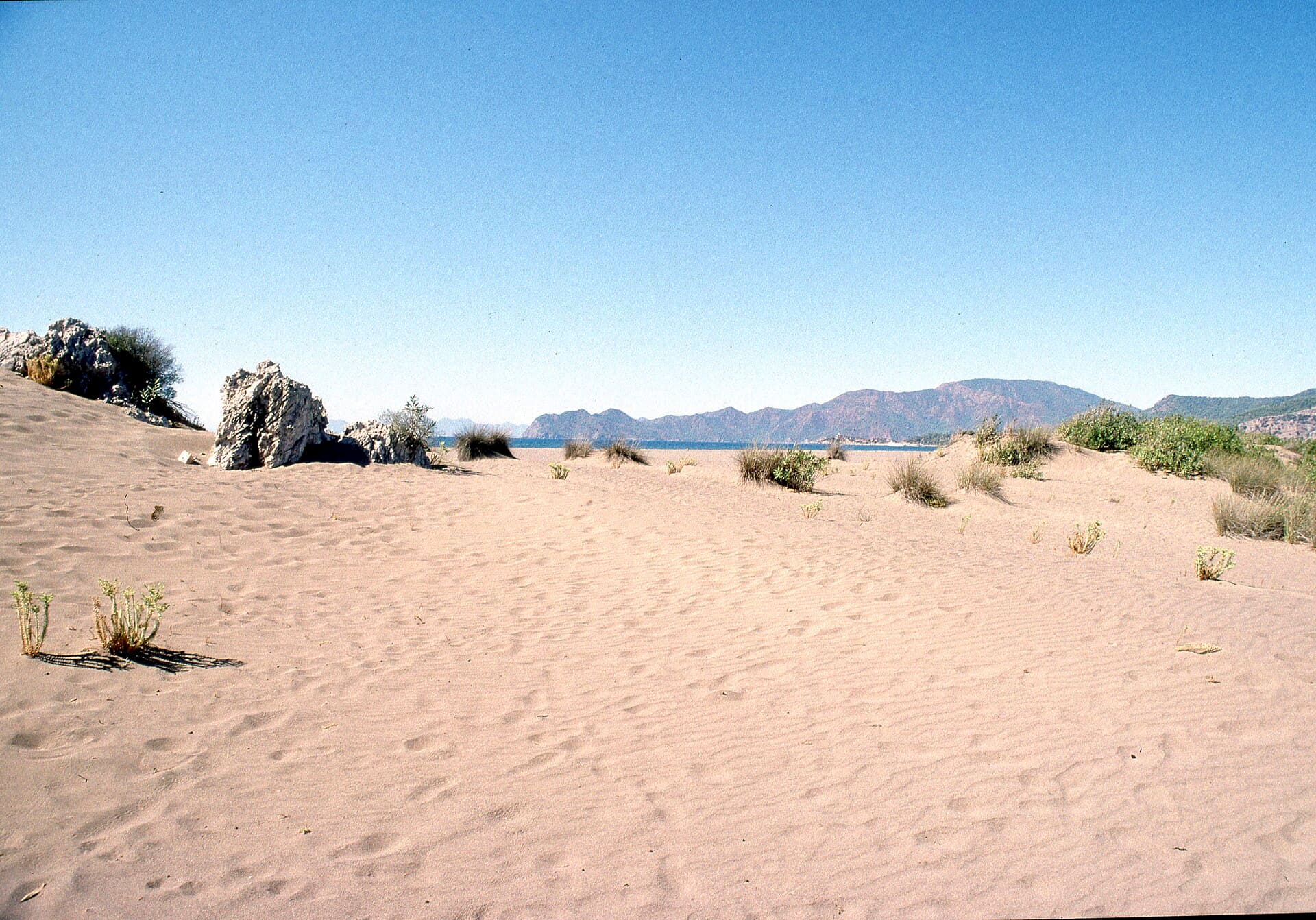
Sandy dunes and scrub at İztuzu Beach with mountains rising beyond

A 4.5km dune beach split between sunbathers and nesting loggerhead turtles — one of Turkey's best swims, with the access rules to prove it.

Formed as the Dalyan delta silted up ancient Kaunos's harbour. In 1987, construction began on a beach hotel here; a campaign led by conservationist June Haimoff, joined by David Bellamy and Nergis Yazgan, drew in the IUCN and WWF. In July 1988, after WWF president Prince Philip appealed to PM Turgut Özal, Turkey blocked the hotel and made İztuzu a Special Environmental Protection Area.

Small conservation/entry fee at the beach gate, paid in lira — reported at roughly €1–2, not independently confirmed to an exact figure.

210 minBeach closed to all visitors 20:00–08:00 from 1 May to 31 October to protect nesting and hatching loggerhead turtles — there is no evening access in season.No direct road runs along this stretch of coast; access is by river boat from Dalyan or a longer inland minibus route, not a short drive.Sunbeds, parasols and digging are banned inside the marked nest zones on the upper sand — keep behind the stakes.
+1 more to know
Fully exposed dune sand with little shade; the sea itself is the relief, not the beach.
Look for: Wooden stakes marking real nest sites on the upper dune — keep behind them. Fresh turtle tracks in the morning sand before they're smoothed over. Cold river mouth at one end, warm sea at the other, a few strides apart.
Rank2
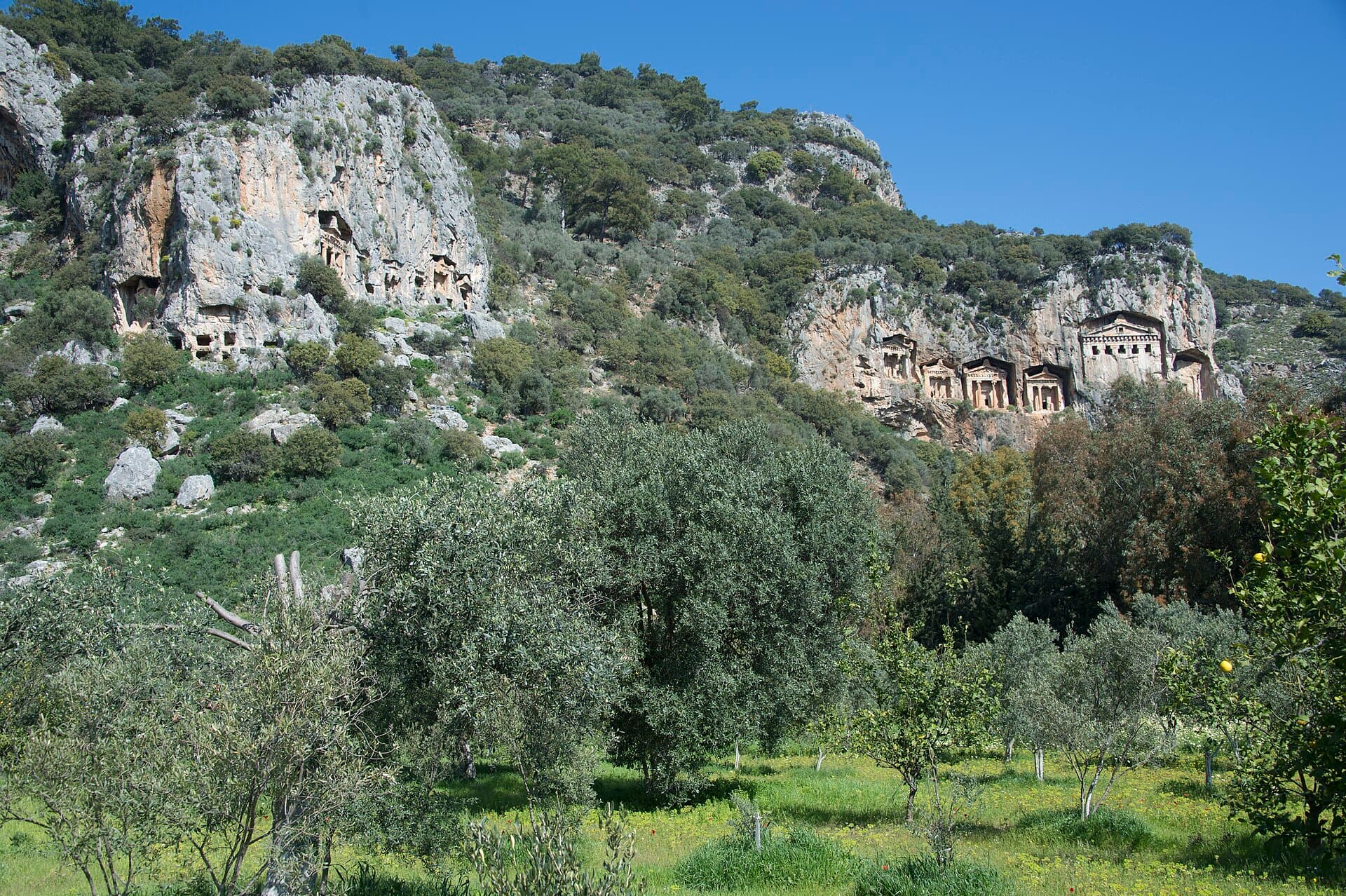
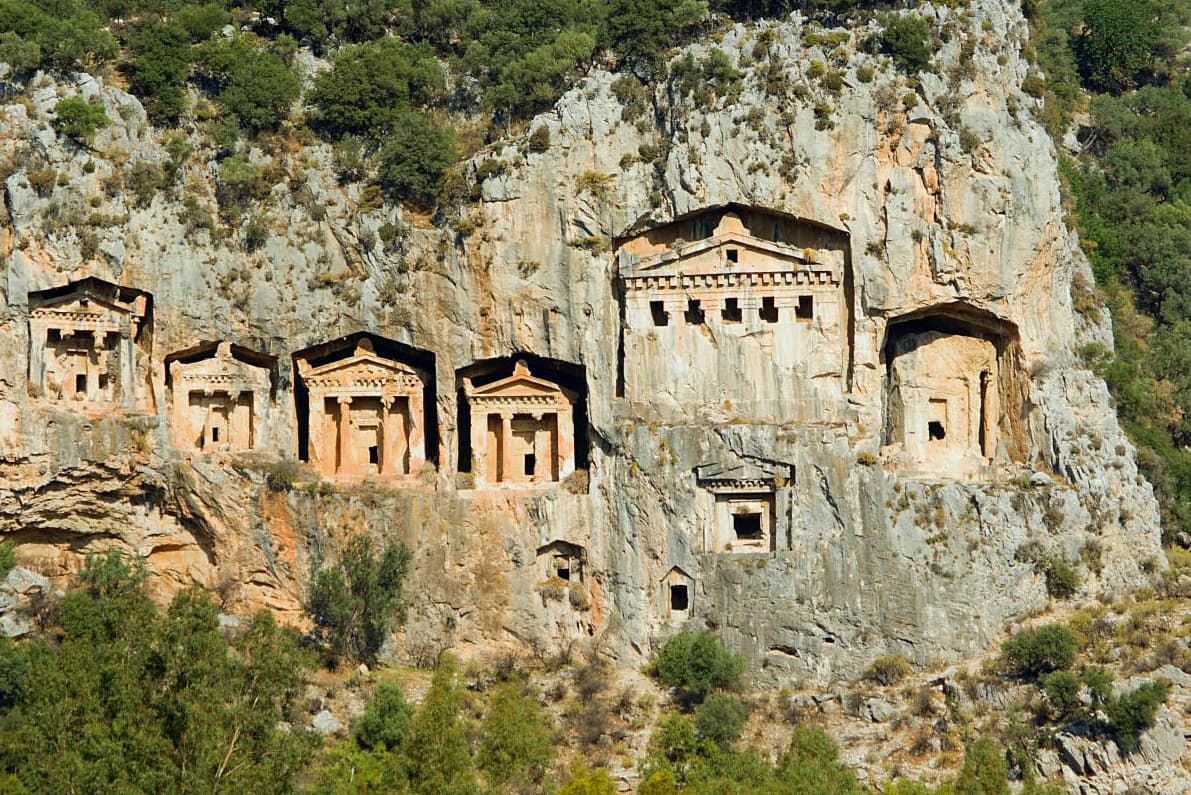
Temple-fronted Lycian rock-cut tombs carved high into the Dalyan cliffside.

Kaunos

Ancient city

Six Lycian tomb facades cut into a cliff above the Dalyan river — genuinely spectacular, and not actually inside the ruins you pay to enter.

Possibly founded as early as the 10th century BC, Kaunos was fought over in turn by Caria, Lycia, Persia and Rome as a working Aegean port. Silt from the Dalyan river pushed the coastline out over centuries until the harbour stranded roughly 8km inland; malaria and depopulation followed, and the city was abandoned by the Ottoman period. Excavation began in 1966 under Baki Öğün and continues today.

€3 for foreign visitors (2026 DÖSİMM tariff); Museum Pass Türkiye accepted.

90 minThe famous rock-cut tombs are not inside the ticketed site — they're carved into a cliff face across the river, viewed from a boat or Dalyan's promenade, and the path up to them from the ruins side has been closed off with a guard present at times.No real shade across the site, and the surrounding marsh adds humidity to summer heat.Reachable mainly by the Dalyan river boats or a short taxi/dolmuş from Dalyan — there is no direct road from Marmaris.
Look for: The temple-fronted rock tombs on the cliff across the river — seen from a boat or Dalyan's promenade, not inside the fenced site. Inside: a Hellenistic theatre, Roman baths, and a harbour temple stranded in reed marsh, far from open water.
Verified · · 30 min to Dalyan
Rank3
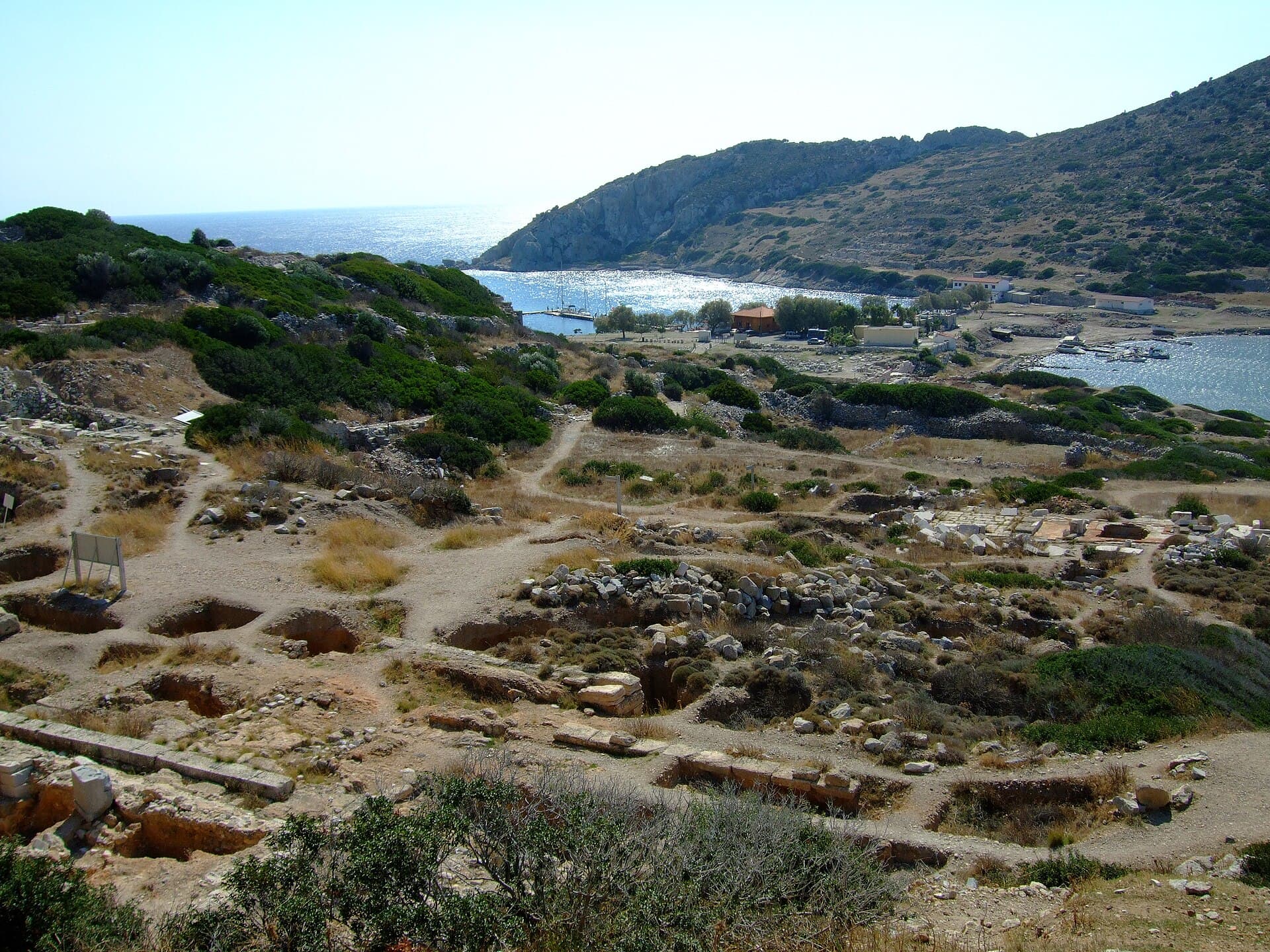
Excavated ruins overlook Knidos's sparkling harbour framed by rocky headlands.

Knidos

Ancient city

The tip of the Datça peninsula, where a lost Praxiteles nude once stood — remote, and one of the longest hauls to any ruin on this coast.

A city of the Dorian Hexapolis positioned where the Aegean meets the Mediterranean, Knidos commissioned Praxiteles to sculpt the Aphrodite of Knidos around the mid-4th century BC — the first life-size nude female statue in Greek art, famous enough that ancient writers describe people sailing here just to see it. The original is lost; the best surviving Roman copy stands in the Vatican Museums.

€5 for foreign visitors (2026 DÖSİMM tariff); Museum Pass Türkiye accepted.

100 minThe drive is genuinely long: about an hour from Marmaris to Datça, then another 35km / 45–60 minutes beyond Datça town, the final stretch narrow and winding along the peninsula ridge. Treat it as a Datça overnight, not a single Marmaris day trip.Little shade across most of the site, on an exposed headland.A visitor-route and infrastructure renovation reached only provisional completion in 2026 — some paths or areas may still be in transition; check locally on arrival.
+1 more to know
Some blue-cruise itineraries call at Knidos harbour by sea, avoiding the road entirely — worth asking about if you're already booking a gulet.
Look for: The circular foundation where Aphrodite's round temple stood, built so the statue could be viewed from every side. Twin harbours either side of the ancient causeway — one naval, one commercial — and a sundial linked to astronomer Eudoxus.
Rank4
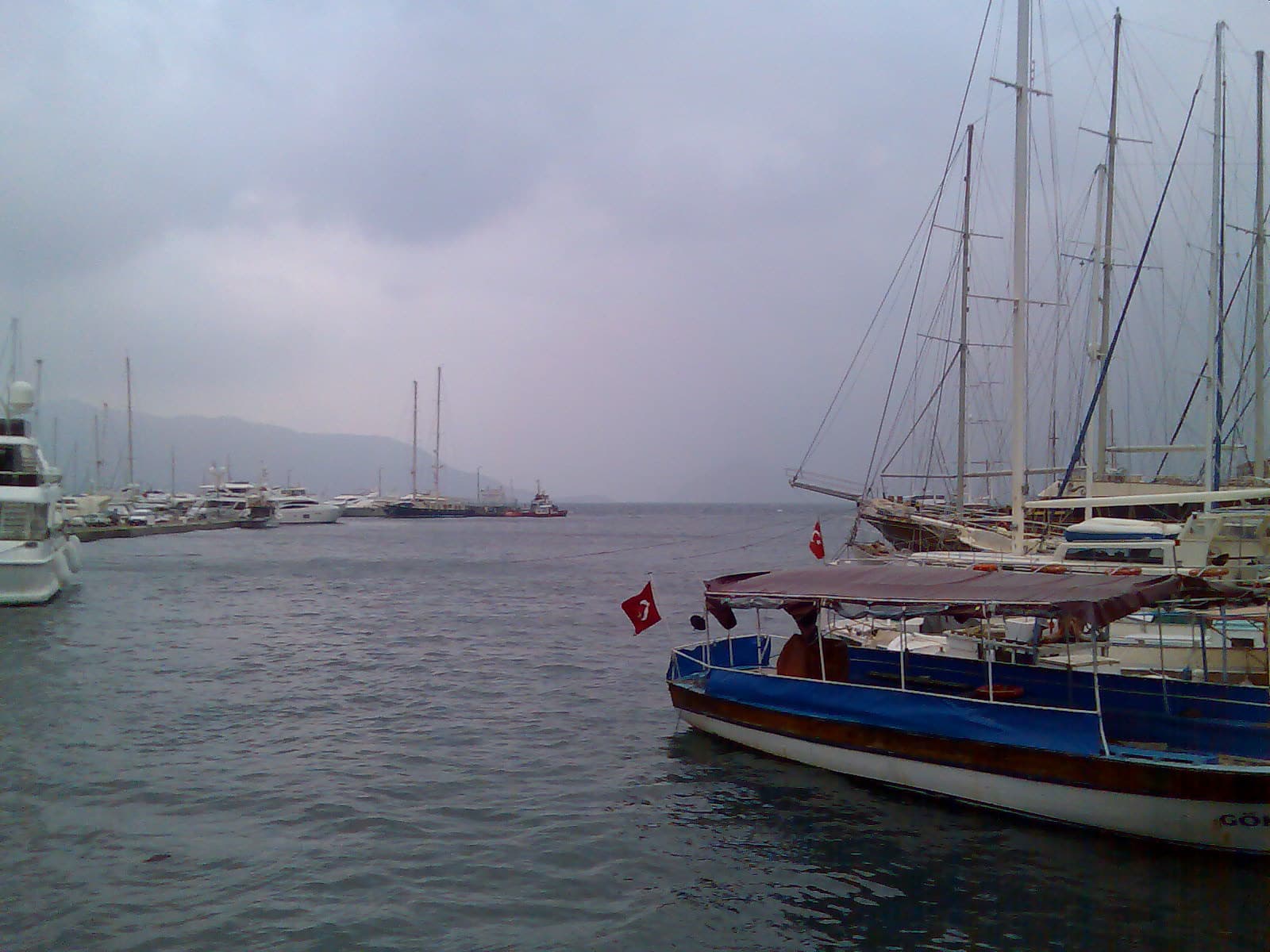
A two-masted wooden gulet moored among yachts at Netsel Marina, Marmaris.

Marmaris's own beach isn't the draw — its harbour is, where wooden gulets leave for three, four or seven days along the coast.

The Blue Cruise ("Mavi Yolculuk") tradition began in 1940s Bodrum around the exiled writer Cevat Şakir Kabaağaçlı, who introduced friends to the Aegean coast by boat. Marmaris grew alongside Bodrum as one of the tradition's two main gulet-building and departure towns, and gulets still set out today from Netsel Marina and the smaller harbours around it.

Shared-cabin multi-day cruises roughly €450–800 per person for 3–4 nights (season/operator-dependent); private full-boat charters vary widely by vessel size and finish — get a direct quote rather than trusting an average. Day-sails also available from the same marinas.

480 minShared-cabin multi-day prices vary heavily by season and boat; treat any single "from" figure as a floor, not a typical price — get a direct quote.The generic all-inclusive day-boat trips advertised around the town beach (BBQ, unlimited drinks, loud music) are a different product from a proper gulet charter — ask specifically for a sailing gulet if that's what you want.Sailing season runs roughly May–October; outside it, boats are laid up and the marina empties out.
+1 more to know
Multi-day cabins on the popular Marmaris–Fethiye route sell out for July–August well in advance.
Look for: Netsel Marina's rows of broad-beamed, two-masted wooden gulets, built in local yards for this work. Two classic routes: east toward Fethiye/Göcek along pine inlets, or west toward Datça and Bodrum, sometimes calling at Knidos.
Rank5
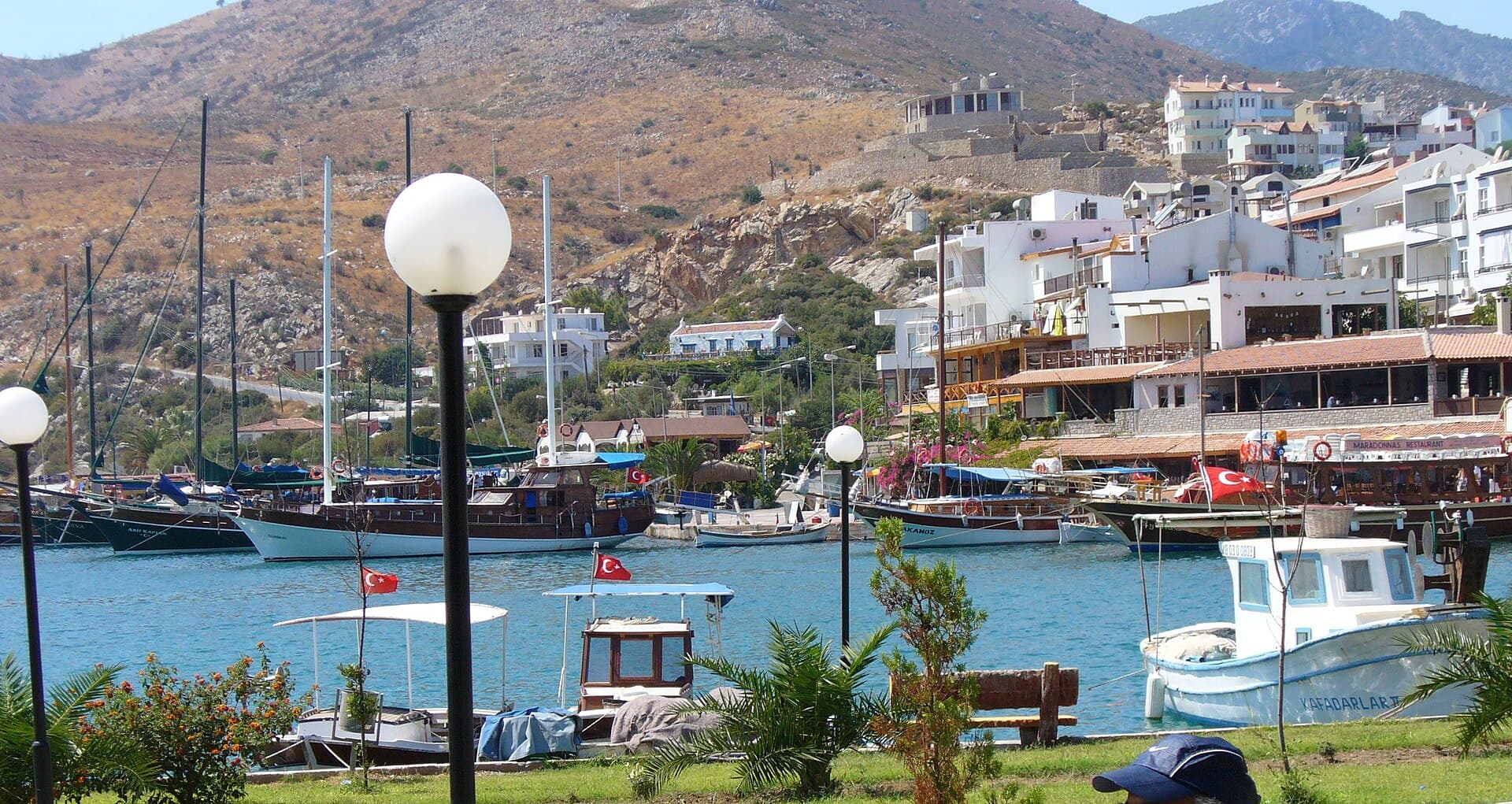
Traditional gulets and fishing boats moored in Datça's working harbour.

Datça

Neighbourhood

The peninsula's own town — sleepier than Marmaris, with almond orchards, a restored quarter, and a new 45-minute ferry to Greece.

Connected to the mainland by an isthmus only a few hundred metres wide, Datça grew as a farming and sponge-fishing town rather than a mass resort. Poet and Shakespeare-translator Can Yücel made it his home until his death and is buried on the hillside above town; the wider peninsula has a long-standing following among cruising sailors and, more recently, rock climbers.

Free to walk the town. Datça–Symi ferry roughly €75 one-way / €130 return (2026, brand-new route — re-verify before publish). Datça–Bodrum car ferry runs up to 4 times daily at peak summer (mid-Jul–mid-Aug), 1–3 times other periods; about 105 minutes each way.

240 minAbout 71km / roughly an hour's drive from Marmaris on a winding but decent road — a realistic day trip on its own, but combine it with Knidos and the round-trip stretches past four hours of driving.The Datça–Symi ferry is new (from 1 June 2026) and runs only Monday and Thursday for same-day returns — check the current schedule before planning around it, and book ahead in summer.Much of the peninsula's own tourism infrastructure closes down from November to April; this is a May–October town.
Look for: The harbour promenade at dusk, when day boats are back and restaurants fill. Datça's three crops — almonds, honey, olives — turn up on every menu. The Symi dock, for a same-day run into Greece this coast can't otherwise offer.
Rank6
Lycian rock-cut tombs carved into the cliff face above Dalyan.

Dalyan

Neighbourhood

A river town with no beach road at all — everything worth doing here (tombs, turtles, mud) is reached by boat through its own delta.

Named for the fish weirs ("dalyan") that have worked the channel between Köyceğiz Lake and the sea for generations, the town grew as a small fishing settlement below ancient Kaunos and turned toward tourism only from the 1980s, when the international campaign to protect İztuzu Beach's nesting turtles put it on the map.

Boat-cooperative day loops (Kaunos + İztuzu + mud baths) run daily in season; exact fares fluctuate and are best confirmed at the riverside ticket booths rather than pre-booked online.

180 minNo road runs along the river itself; the sights that define a Dalyan visit (tombs, Kaunos, İztuzu, mud baths) are reached by boat, not on foot or by car.Direct dolmuş from Marmaris is limited — most public transport connections change at Ortaca, about 8km short of town.River boat services to İztuzu and the mud baths run in season only; expect a much quieter, boat-free town November to April.
Look for: The rock tombs on the cliff face opposite town, best seen from the riverside promenade at golden hour. Flat-bottomed river boats loading for the reed channels each morning. Grey mullet from the lake-to-sea migration on local menus.
Verified · · 30 min to Kaunos

Worth your time

Worth your time

A second day earns you these.

Rank1

Marmaris Castle & Archaeology Museum

Museum

Süleyman the Magnificent's staging fort for the 1522 Rhodes campaign, now an 18-room museum you can do properly in under an hour.

Rebuilt from an earlier fortification in 1522 as a garrison and supply base for the Ottoman fleet's campaign against the Knights of Rhodes. Restored between 1980 and 1990, it reopened as an archaeology and ethnography museum in 1991, with finds from across the district.

€6 for foreign visitors (2026 DÖSİMM tariff); Museum Pass Türkiye accepted. Seasonal night-museum slot 19:00–22:00 when running.

50 minSmall by the standard of major Turkish museums — closer to an hour than a half-day, even for an interested visitor.Largely indoor and shaded ramparts aside; a reasonable midday option when the beaches are at their hottest.The seasonal night-museum slot (when running) offers an evening alternative to a daytime visit — confirm current dates before planning around it.
Look for: Ramparts giving one of the few elevated views over the harbour and marina. Inside, the ethnography hall's local folk-life exhibits alongside the archaeological finds.
Open in Maps
Rank2

Sultaniye Hot Springs & Mud Baths

Natural site

Sulphur pools and a mud pit on Köyceğiz Lake's shore, reached only by boat — the unglamorous stop on every Dalyan river-loop itinerary.

Fed by thermal springs on Köyceğiz Lake's southern shore, Sultaniye has been used informally by villagers from the lake side for generations, before boat-borne tourism turned it into a fixture of the Dalyan day loop, paired on most itineraries with Kaunos and İztuzu Beach.

Small entry fee paid in lira at the gate; exact figure not independently confirmed — budget a modest cash amount.

60 minSulphur water and mud stain light-coloured swimwear — bring something you don't mind marking.Facilities are basic and functional rather than a spa experience; treat it as a novelty stop on the boat loop, not a destination in its own right.Reached only as part of the Dalyan river-boat system — no independent road access.
Look for: The grey mud pit where everyone photographs everyone else mid-coat, and the warm sulphur pools used to rinse it off. A faint rotten-egg smell that means the minerals are working, not that anything's wrong.
Open in Maps
Rank3

Eski Datça (Old Datça)

Neighbourhood

A hillside quarter of restored stone houses above Datça harbour — bougainvillea, guesthouses, and the grave of the poet who lived there.

The older settlement above Datça's modern harbour, largely emptied through the 20th century as the town's centre of gravity moved to the waterfront. From the 1980s its stone houses were restored one by one into guesthouses, cafés and galleries; poet and Shakespeare translator Can Yücel lived here until his death and is buried on the hillside.

Free to walk; cafés and restaurants at normal town prices.

70 minA short but genuine uphill walk from Datça's harbour front, on cobbles — comfortable shoes matter more than the short distance suggests.Small enough that an hour covers the lanes properly; treat it as a stop within a Datça evening, not a destination on its own.Some guesthouses and galleries close or reduce hours outside the May–October season.
Look for: Bougainvillea-covered stone facades along the cobbled lanes. Can Yücel's grave and the small square near it. Workshops and galleries in restored houses rather than a formal museum circuit.
Open in Maps
Rank4

Marmaris Bazaar & Kaleiçi Old Town

Market

The old quarter around the castle, where lanes of leather, spice and souvenir stalls are what's left of Marmaris before the resort strip.

Kaleiçi, the neighbourhood in and around the old castle walls, is the original town core the post-1980s hotel boom grew out from. It survives as Marmaris's bazaar district — covered and open-air stalls, workshops and small restaurants threaded through lanes too narrow for the traffic that defines the rest of town.

Free to browse; bargaining expected at souvenir and leather stalls, less so at food stalls.

75 minPersistent stall-front invitations to browse are standard here; a polite decline works as well as anywhere else in Turkey.Prices on unmarked souvenir and leather goods assume a bargaining opener well above the real price.Busiest and most atmospheric in the evening; a midday summer visit is quieter but flatter.
Look for: Leather goods and counterfeit-brand stalls alongside genuine local produce — spices, dried fruit, olive-oil soap. Bargaining is expected on the former, not really on the latter.
Open in Maps

If you have longer

If you have longer

Keep these compact stops in mind when you build your trip.

A former fishing and sponge-diving village, İçmeler grew into a resort in its own right from the 1990s without fully merging into central Marmaris. It remains administratively and atmospherically distinct: quieter, more pine forest, less nightlife.

Free public beach access; sunbed/umbrella hire in lira from front-facing cafés and hotels.

Still a developed resort strip, not an escape from tourism — the honest comparison is "better than central Marmaris," not "undiscovered."Sunbeds and umbrellas on the busiest stretches are tied to specific hotels or cafés; a public-access section exists but gets crowded in August.Reached by frequent dolmuş from central Marmaris (roughly 15–20 minutes) — no need to book a taxi.
165 minOpen in Maps

Turunç

Beach

A former fishing village on its own cove south of Marmaris, connected by a corniche road that is itself one of the more scenic short drives on this coast. Turunç has grown into a small resort but stayed a fraction of Marmaris's size, with a Blue Flag beach as its main draw.

Free public beach; dolmuş fare in lira from Marmaris, or included as a stop on boat-trip packages.

About 20km from central Marmaris by a winding coast road — dolmuş service exists but is slower than the distance suggests.A standard stop on the all-inclusive Marmaris boat-trip circuit, so late-morning arrivals can be genuinely crowded even though the village itself stays small.Limited beyond the beach and a modest village centre — this is a swim-and-lunch stop, not a half-day of sightseeing.
100 minOpen in Maps

Getting there and away

Verified routes from Marmaris.

Door-to-door times and fare ranges, checked leg by leg. Only routes where every leg verified are listed.

Getting around

Türkiye, for scale

Where it sits

See this city in the wider shape of Türkiye.

The map will load as it approaches the viewport.