TurQuosian

Black Sea

Sumela

A monastery cut into the cliff face

Sümela is a Byzantine Greek Orthodox monastery built into a sheer cliff face above the Altındere valley, a separate trip from Trabzon city itself. A record 514,596 people visited in 2025. Cars stop at a lower car park — a shuttle or a forest trail covers the last stretch — and the frescoed rock church rewards a slow, close look rather than a quick pass-through.

Elevation
~1,200m
Cliff height
~300m above the valley
2025 visitors
514,596 (record)
Access
Shuttle from the car park
From Trabzon
~45–50km, ~1 hour
Entry (foreign)
€20

Every published place in one city guide

What to see in Sumela.

Start with the essentials, add what genuinely interests you, and leave the rest for another visit. Every place includes a concise story, practical timing, a Maps link, and a one-tap route planner action.

Make the route work

Anticipate the practical details.

Getting there

Trabzon is the gateway — Trabzon Airport (TZX) connects to Istanbul and other domestic points, and is the base most visitors stay in and day-trip from (Trabzon city itself is covered on its own page). From Trabzon, Sümela is roughly 45–50km and about an hour by road via Maçka. Seasonal minibuses reportedly run more directly from Trabzon in summer; year-round, the reliable route is Trabzon–Maçka by dolmuş or bus, then an onward transfer, taxi, or organised tour for the final stretch into the valley — confirm current dolmuş schedules locally rather than assuming a direct year-round service.

Getting around

Private cars and tour coaches stop at a paid car park in the valley — nothing drives to the monastery entrance itself. From there, a shuttle or a forest walking path of roughly 20–30 minutes covers the last stretch, ending in steps up to the entrance either way. Budget two to three hours total for the round trip including the walk in, the monastery itself, and the walk out.

Money

Foreign-visitor entry is €20, confirmed against the Ministry of Culture and Tourism's own tariff table. Turkish citizens enter via Müzekart per the same official listing; a reliable walk-up TL price for citizens without a Müzekart could not be confirmed — expect to pay in euros or lira at the day's rate, and bring cash for the car park and shuttle fees, which are separate from the entrance ticket.

Connectivity

This is a forested mountain valley; mobile coverage can be patchy in places even though it is a heavily visited site. Download offline maps before the trip rather than assuming a signal throughout.

Etiquette

This remains a consecrated Orthodox Christian site, with an annual Divine Liturgy tradition dating to 2010 — behave as you would at any active place of worship: quiet voices in the rock church, no touching the plaster, modest dress appreciated though not strictly enforced for the museum visit.

Safety and comfort

Steep, uneven, historic stone steps and stairways throughout, worse when wet or misty — this is a mountain site, not a levelled museum floor. The valley sits at roughly 1,200m elevation and stays noticeably cooler and mistier than the Trabzon coast even in summer; bring a layer. Wildlife including bears and wolves is native to the wider national park, though sightings near the main visitor route are rare.

Essential

Don’t leave without

If you only have one day, this is the day.

Rank1
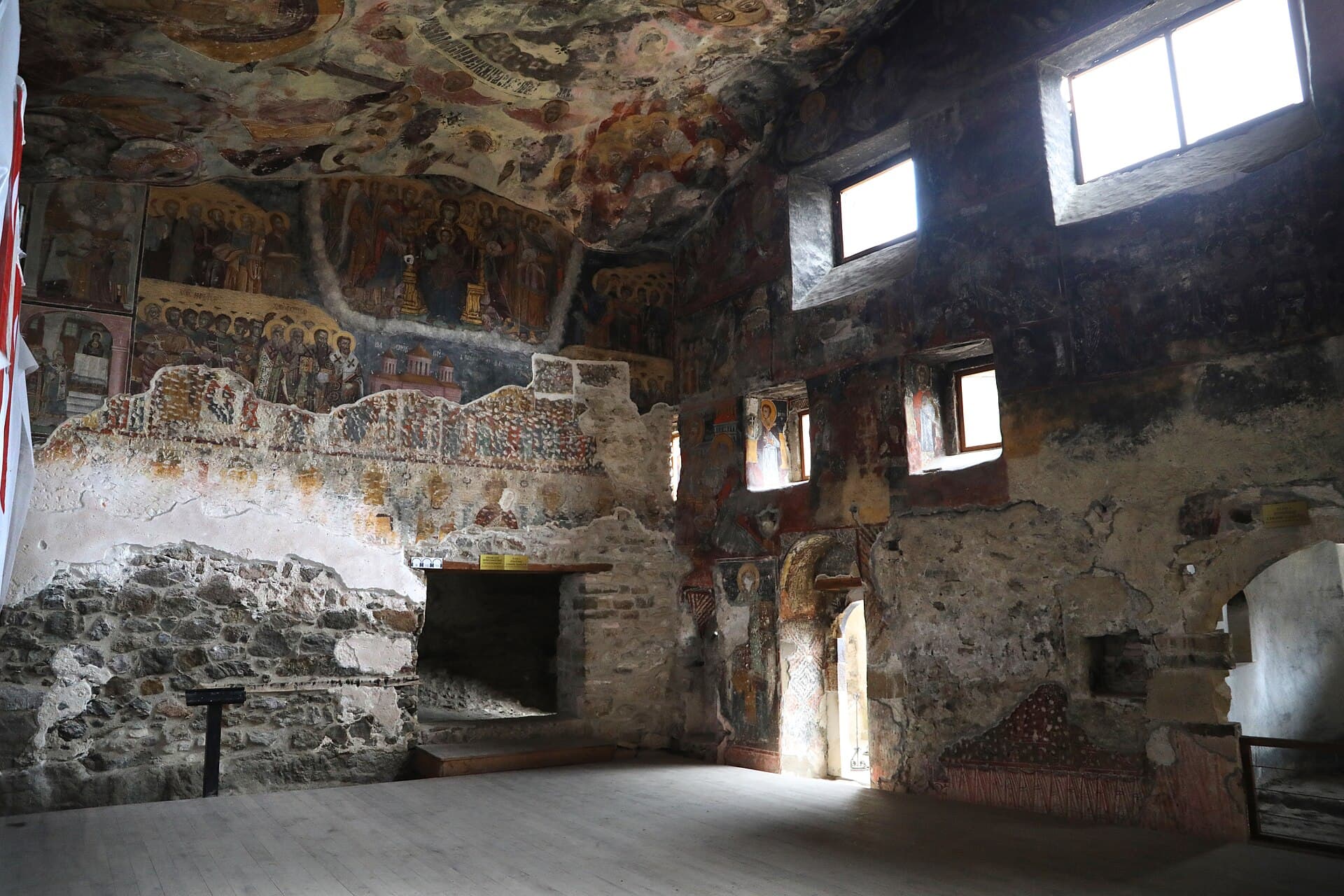
Painted saints and rock-cut windows inside Sümela's frescoed rock church chapel

The Rock Church

Religious site

Faces of saints at eye level, close enough to touch — painted to be lived with and prayed toward, not admired from a cathedral floor.

Cut directly into the cliff, the rock church holds painting from several phases spanning roughly the ninth to nineteenth century, including work tied to Trebizond emperor Alexios III in the 1300s and chapel scenes dated to the early 1700s. Centuries of visitors scratched names into the lower panels. A Ministry restoration begun May 2024 has worked scene by scene since, including the exterior Last Supper.

30 minFresco restoration has been active since May 2024 and is ongoing; scaffolding or covered panels are possible on any given visit, even though the interior read clearly with no scaffolding as of the most recent on-the-ground account (August 2026).Some lower panels carry real vandalism damage — centuries of scratched names — which is what the restoration is fixing, not evidence that it has failed.Small, dim, and single-file in places; a tour group ahead of you means a genuine wait, not a way around them.
+1 more to know
Covered by the single Sümela Monastery ticket — no separate charge.
Look for: Where a cleaned panel meets an unrestored one — the join shows what nine centuries and scratched names did to painted plaster. The 2015–2017 restoration also found a hidden chapel behind a secret tunnel, with frescoes of heaven and hell.
Verified · · 1 min to Sümela's Cliff Face · 1 min to The Monks' Quarters, Kitchen and Library
Rank2
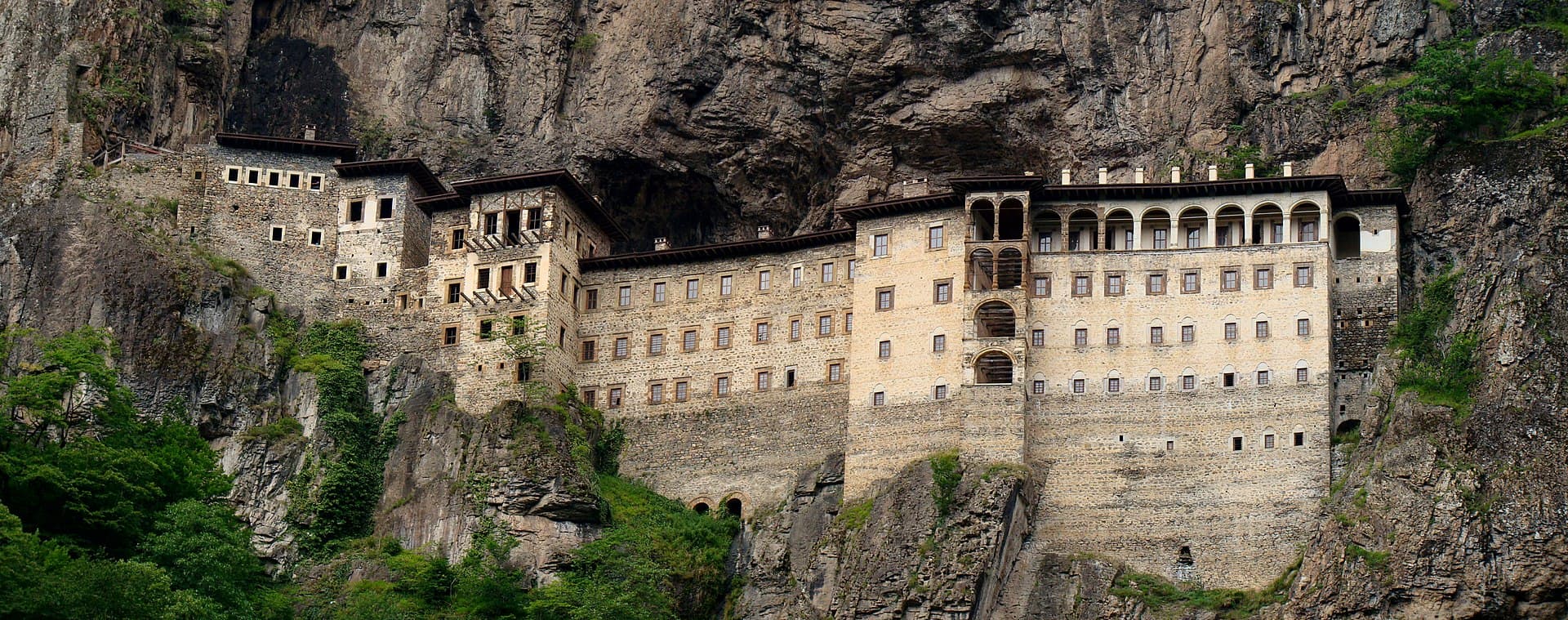
Sümela Monastery's multi-storey building built into a sheer cliff, seen across the valley

The building doesn't sit on the cliff, it grows out of it — floor after floor stacked roughly 300 metres up a sheer rock face.

Tradition holds the monastery was founded around AD 386 by two Athenian monks seeking an icon of the Virgin attributed to the Apostle Luke. Belisarius enlarged it under Justinian in the sixth century; it reached its present form in the 13th–14th century under Trebizond, whose emperor Alexios III granted it tax-exempt land by an imperial 1365 charter. Rockfall risk shut it from September 2015 to July 2021.

45 minStructural rockfall closure ran from September 2015 to July 2021 — sources and guidebooks written before 2021 describe a monastery you could not actually enter. Treat anything undated with suspicion.The final approach is steps and an inclined path whether you take the shuttle or walk — there is no step-free route to the entrance.No shade on the aqueduct approach or the forecourt; the interior is cool, the exterior stone is not.
+1 more to know
Cars and tour coaches stop at the lower car park — nothing drives to the entrance itself (see the Altındere Valley Trail).
Look for: The stone aqueduct striding across the approach on arches — it carried the complex's only reliable water on a cliff where a well was never an option. The 1840 balcony wing is the newest thing here by centuries; the rest is older.
Verified · · 1 min to The Rock Church · 1 min to The Monks' Quarters, Kitchen and Library

Worth your time

Worth your time

A second day earns you these.

Rank1
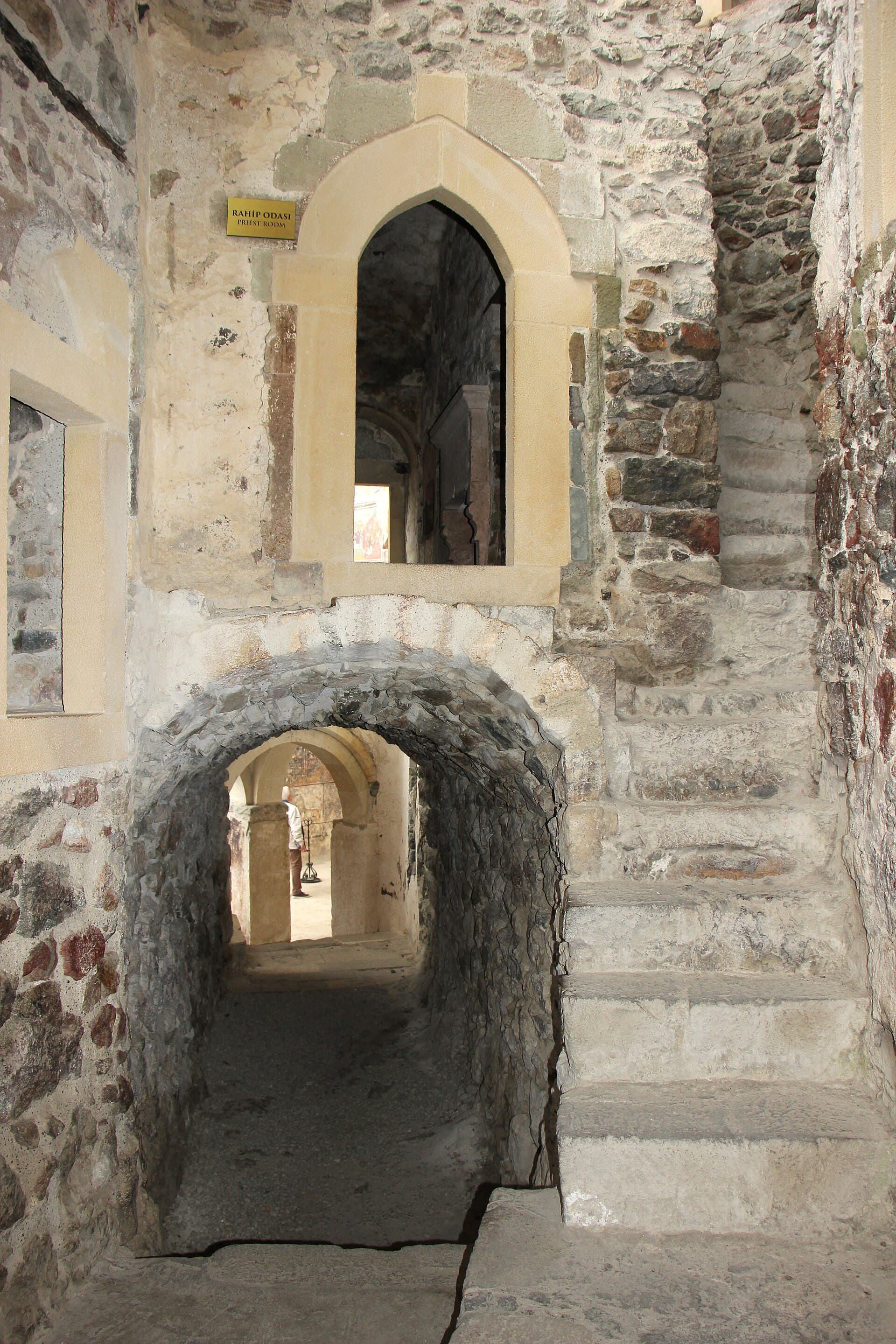
Stone stairway and archway inside a passage at Sümela Monastery's monks' quarters

Seventy-two rooms stacked three and four storeys into the rock explain how a remote cliff monastery actually functioned day to day.

North and east of the rock church, monks' cells were cut and built into every usable cavity in the cliff face — reportedly 72 rooms across multiple floors, connected by corridors and stairways. The complex included a kitchen built across two levels and a library, now empty. A fire in 1930, after the site had already been abandoned, destroyed most of the surviving woodwork inside.

25 minMultiple staircases and uneven rock-cut steps with low doorways — awkward for anyone with mobility limitations or claustrophobia.Almost no original woodwork survives after the 1930 fire; expect bare stone and reconstructed structure, not furnished rooms.Poorly lit lower corridors — a phone flashlight genuinely helps, not just a nice-to-have.
+1 more to know
Covered by the single Sümela Monastery ticket — no separate charge.
Look for: The stacking of floor on floor, easier to read from inside than from the valley floor, where distance flattens it into one facade. Look for hearth traces in the kitchen and corridors linking cells that housed a self-sufficient community.
Verified · · 1 min to The Rock Church · 1 min to Sümela's Cliff Face
Rank2
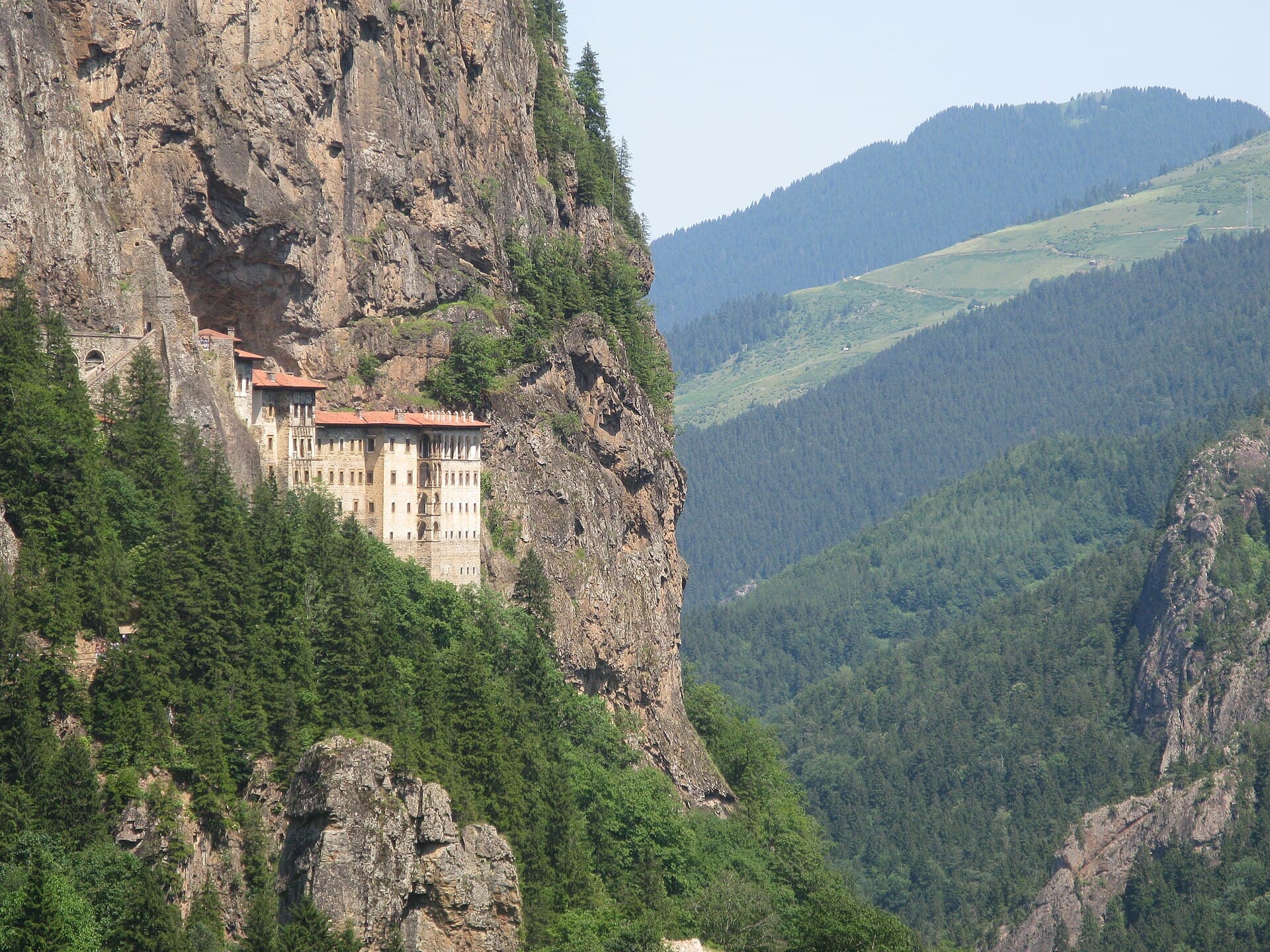
Sümela Monastery on a cliff face, with the forested Altındere valley stretching beside it

The only spot that shows you the whole building at once — inside the monastery, you're standing on it, and you can't see it.

A viewing terrace on the opposite slope of the Altındere gorge, facing the monastery cliff directly. Multiple Turkish sources describe it as gaining its reputation partly during the 2015–2021 structural closure, when it was the only way to see the building at all; further designated viewing points along the same slope were reported added in 2026.

15 minCoordinates here are an estimate of the opposite-slope viewing area, not a single surveyed point — several viewing spots exist along that slope, expanded as recently as 2026. Confirm the exact location before publishing.Morning mist that makes for good photos can also mean a genuinely obscured view for the first hour or two after sunrise — it isn't guaranteed to clear on any given visit.No barrier at every point along the slope; keep real distance from the edge, especially on wet rock.
Look for: Morning mist sitting in the valley below the cliff, and low, gold light on the rock face before the sun climbs high enough to flatten it. From here, and only from here, the full stacked composition reads as one frame.
Verified · · 15 min to The Rock Church · 15 min to Sümela's Cliff Face
Rank3

The Altındere Valley Trail

Natural site

The forest path is the free alternative to the shuttle, and the reason this valley is a national park, not just a monastery car park.

Altındere Valley National Park, around the monastery in Maçka district, is defined by the district government around "the monastery and the valley's botanical diversity and geomorphological structure" — spruce, pine, chestnut and oak forest, with deer, wild goats, wild boar, and rarer bears, wolves and jackals recorded park-wide. The district government lists the main season as April through late October.

45 minVehicles cannot drive to the monastery on any route — the car park and shuttle system apply valley-wide, not just to one entrance.Specific winter closure dates could not be confirmed — weather can restrict valley access from roughly December to March, so check locally before a cold-season visit.Natural forest surface, not paved; genuinely slick after rain.
+2 more to know
Brown bears, wolves and wild boar are native to the wider park, per the district government's own listing; sightings near the main trail are rare, but this is not a manicured city park.Coordinates are an estimate of the car park/trailhead area, not independently surveyed — confirm before publishing.
Look for: The mixed spruce-and-broadleaf canopy closing overhead, the Altındere river running alongside the path, and the sudden first sight of the cliff face through the trees — most visitors' actual introduction to the monastery, shuttle or not.
Open in Maps

If you have longer

If you have longer

Keep these compact stops in mind when you build your trip.

Aya Varvara Chapel

Religious site

A small dependent chapel on the rocks above where the approach road ends, historically one of several subsidiary chapels attached to Sümela. Multiple sources identify it as the chapel where the departing monastic community buried the monastery's founding icon in 1923, before a monk secretly retrieved it in 1930; the icon has been enshrined in a monastery of the same name in Greece since 1952.

Access is inconsistent and thinly documented — one source mentions turnstiles being installed at its trail entrance, which reads as a visiting system still being formalised rather than an established, reliable visit. Do not plan a trip around being able to get inside.Reached only by a further, rougher stretch of path beyond the main monastery; most standard visits do not attempt it.Coordinates are an approximate location above the main complex, not independently surveyed — treat as indicative only and confirm before publishing.
20 minOpen in Maps

Getting there and away

Verified routes from Sumela.

Door-to-door times and fare ranges, checked leg by leg. Only routes where every leg verified are listed.

Getting around

Türkiye, for scale

Where it sits

See this city in the wider shape of Türkiye.

The map will load as it approaches the viewport.