TurQuosian

Aegean

Bergama

Where Satan's throne stood

Bergama is ancient Pergamon: a hilltop acropolis reached by cable car, a pioneering healing sanctuary at the Asklepion, and one of the seven churches addressed in the Book of Revelation. It sits inland from the Ayvalık coast, easily combined with the Aegean cluster to its west.

Stay
1 day
Best months
Apr–Jun, Sep–Oct
Nearest coast
Ayvalık, ~1h by road

Every published place in one city guide

What to see in Bergama.

Start with the essentials, add what genuinely interests you, and leave the rest for another visit. Every place includes a concise story, practical timing, a Maps link, and a one-tap route planner action.

Make the route work

Anticipate the practical details.

Getting there

Bergama has no airport of its own — most visitors fly into İzmir Adnan Menderes (ADB), about 100km south, and continue by intercity bus or rental car, or arrive by bus from Ayvalık or İzmir. The otogar (bus station) sits a short taxi ride from the town centre and the acropolis cable-car base station.

Getting around

The acropolis is reached by a cable car (teleferik) from a base station on the edge of town — a taxi or short walk gets you there from most central hotels. The Asklepion and Red Basilica are both walkable from the town centre, roughly 15-20 minutes on foot, though a taxi is easy and cheap if the day is hot.

Money

Carry a payment card and some Turkish lira — the acropolis, Asklepion, and Red Basilica each charge separate entrance fees, and small cafés in town may prefer cash. Müze Kart is accepted at all three state-run sites.

Connectivity

Mobile coverage is reliable across the town centre and all three main sites, including on the acropolis hilltop.

Etiquette

Bergama is a modest provincial town rather than a resort — dress and behave accordingly, especially around the Kızıl Avlu, part of which still functions as a small mosque. Photography is generally fine at all sites unless posted otherwise.

Safety and comfort

Bergama is a low-key, safe town with normal precautions. The acropolis hilltop has some steep, uneven, and unguarded drops near the theatre — watch your footing and supervise children closely.

Essential

Don’t leave without

If you only have one day, this is the day.

Rank1
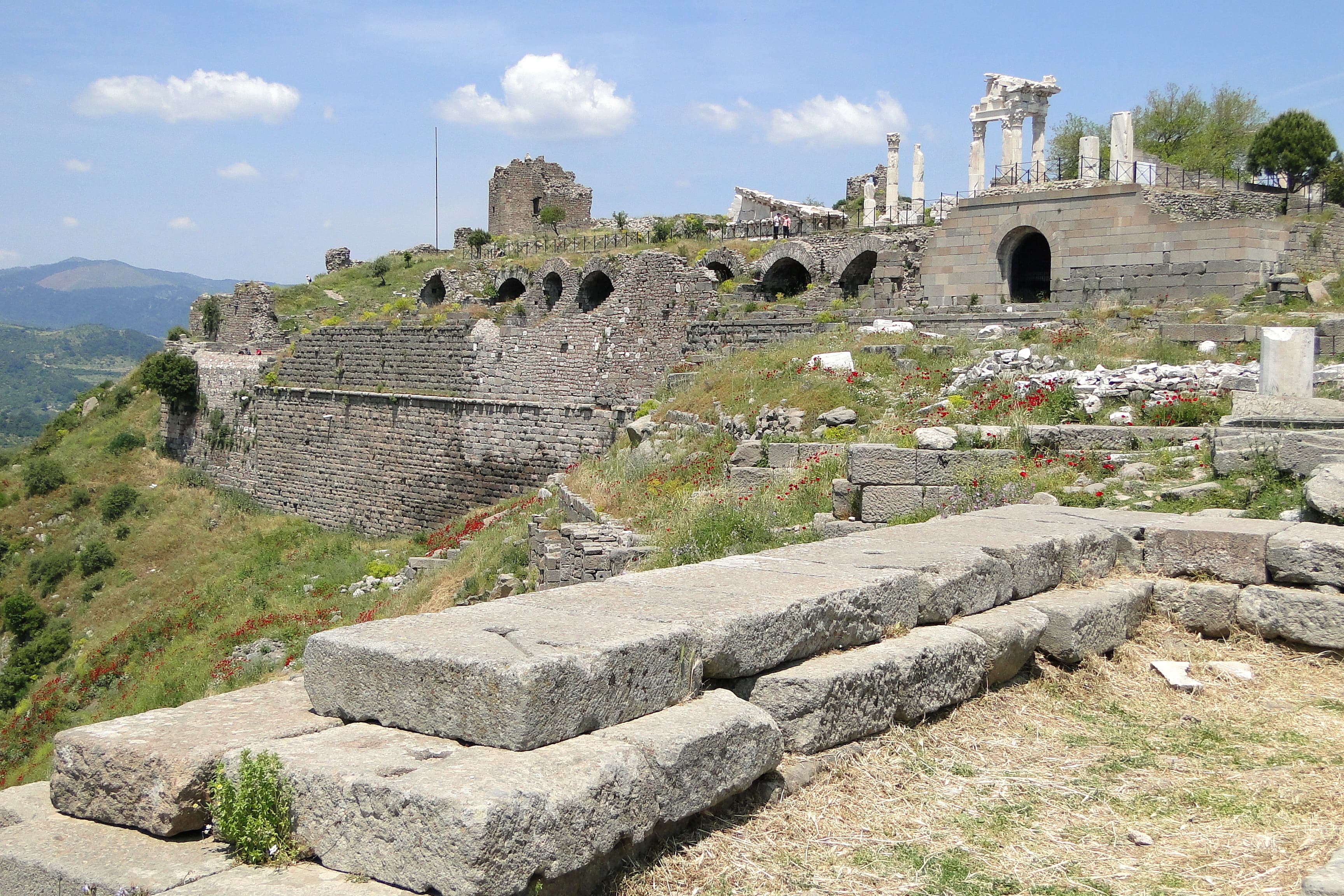
The ruins of the Pergamon acropolis above Bergama, seen from the hilltop site.

Pergamon Acropolis

Ancient city

A cable car lifts you 300 metres above Bergama to the Attalid kings' hilltop capital, its steeply raked ancient theatre cut into the slope.

Pergamon was capital of the Attalid dynasty (282-133 BCE), a Hellenistic kingdom that rivalled Alexandria for scholarship and art. The acropolis held the royal palace, the Library of Pergamon, the Temple of Trajan, and a steeply raked theatre seating around 10,000. Pergamon is named in Revelation 2:12-13 as one of the seven churches of Asia, called the city "where Satan's throne is."

Separate ticketed entrance plus cable car fare, payable on site

120 minSteep, uneven, and in places unguarded drops near the theatreLittle shade on the exposed hilltop
Look for: The theatre's extreme 36-degree rake carved directly into the hillside, the Temple of Trajan's standing columns, and the panoramic view over the Bakırçay plain and modern Bergama below.
Rank2
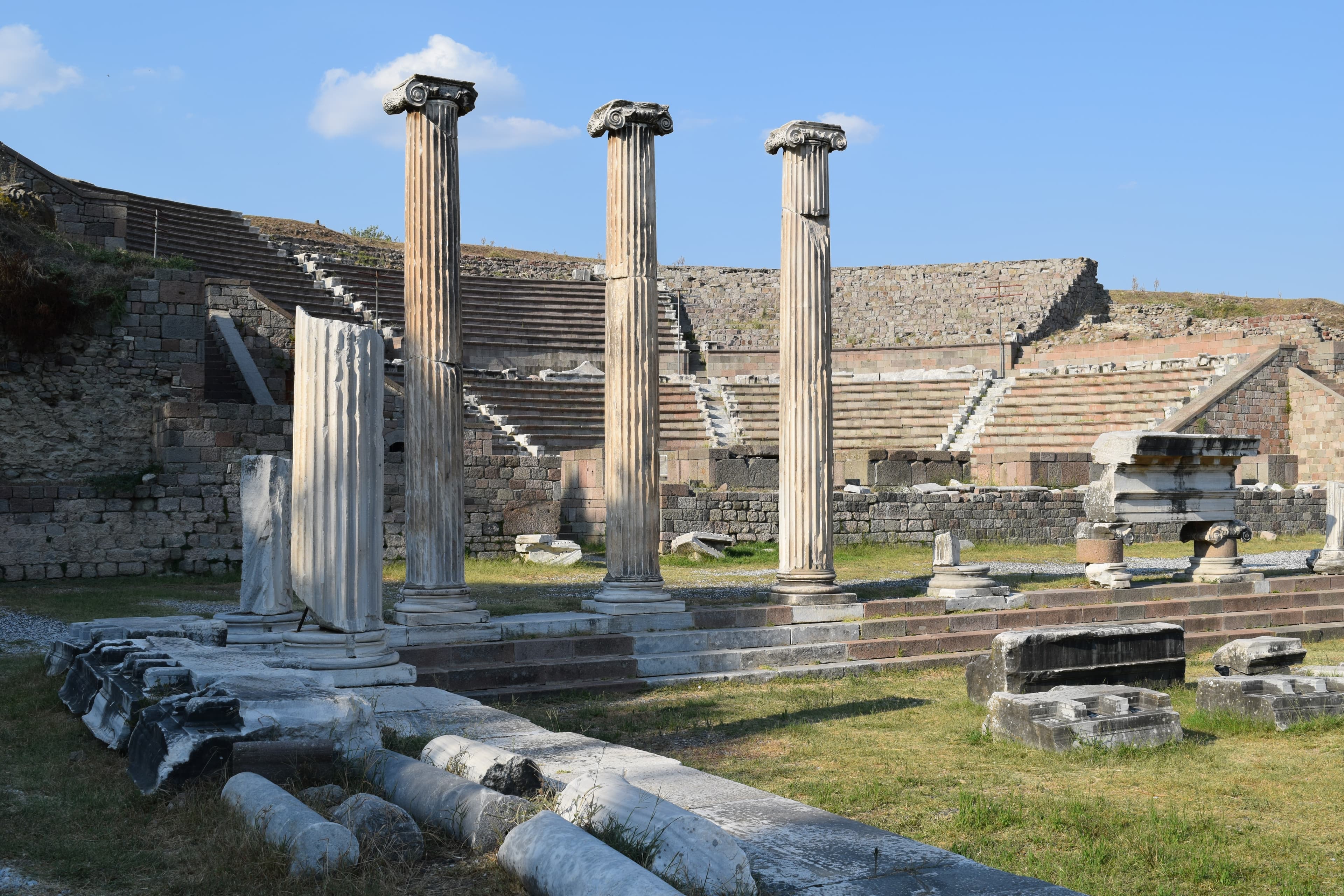
The colonnaded sacred way and ruins of the Asklepion healing sanctuary near Bergama.

Asklepion of Pergamon

Archaeological site

One of the ancient world's leading medical centres, where patients slept hoping the god Asclepius would prescribe their cure in a dream.

The Asklepion was a healing sanctuary dedicated to Asclepius, active from around the 4th century BCE and reaching its monumental Roman-era form under Hadrian (117-138 CE). The physician Galen trained here. Treatment combined cult ritual — dream incubation in the sleeping hall — with mud baths, controlled diet, exercise, and theatre.

Separate ticketed entrance, payable on site

75 minLittle shade across most of the site
Look for: The colonnaded sacred way (Via Tecta) connecting the site to the ancient city, the circular temple of Asclepius, the underground tunnel linking the treatment rooms, and the small theatre used for therapeutic performances.

Worth your time

Worth your time

A second day earns you these.

Rank1
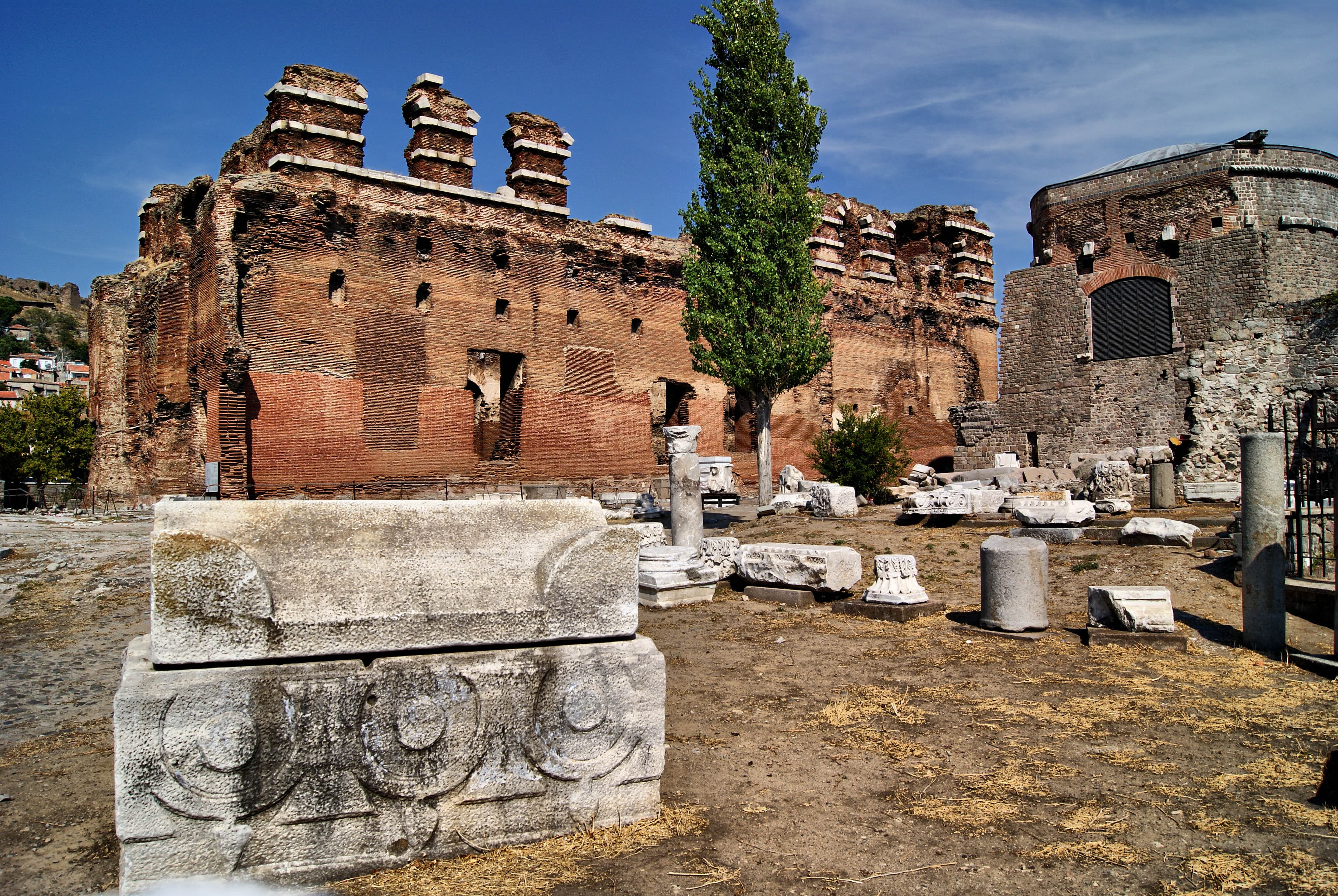
The red-brick walls of the Red Basilica (Kızıl Avlu) in central Bergama.

A vast Roman temple to Egyptian gods, later reworked into a Byzantine church, still dominating central Bergama with its red-brick bulk.

Built in the 2nd century CE for the worship of Serapis, Isis, and Harpocrates, the Red Basilica (Kızıl Avlu) ranks among the largest Roman religious structures surviving in the Greek world. After fire gutted the temple, it was rebuilt in the 5th century as a Christian basilica. It was likely destroyed in the Arab siege of 716-717; after 1336 part of it became a mosque, a use one tower retains today.

Ticketed entrance, payable on site

45 minPart of the complex is a working mosque — dress and behave respectfully, especially near prayer times
Look for: The immense red-brick walls and rotundas visible from central Bergama, the Byzantine-era apse cut into the eastern end, and the small still-functioning mosque inside one of the flanking towers.

Getting there and away

Verified routes from Bergama.

Door-to-door times and fare ranges, checked leg by leg. Only routes where every leg verified are listed.

Getting around

Türkiye, for scale

Where it sits

See this city in the wider shape of Türkiye.

The map will load as it approaches the viewport.