Red Basilica (Kızıl Avlu)
A vast Roman temple to Egyptian gods, later reworked into a Byzantine church, still dominating central Bergama with its red-brick bulk.
Enough context, no spoilers
Why it matters
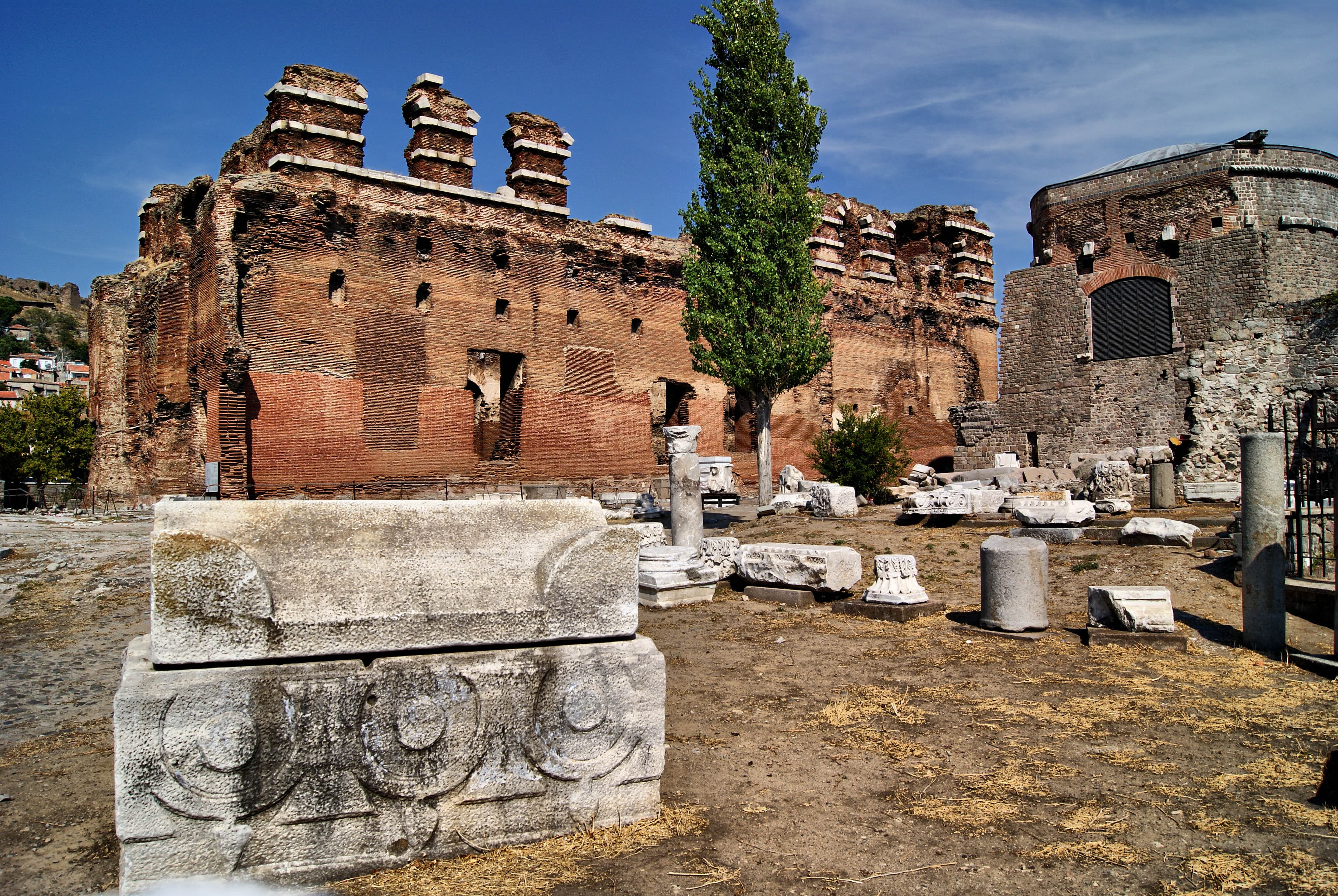
Built in the 2nd century CE for the worship of Serapis, Isis, and Harpocrates, the Red Basilica (Kızıl Avlu) ranks among the largest Roman religious structures surviving in the Greek world. After fire gutted the temple, it was rebuilt in the 5th century as a Christian basilica. It was likely destroyed in the Arab siege of 716-717; after 1336 part of it became a mosque, a use one tower retains today.
What to know before you go
The Kızıl Avlu is impossible to miss from almost anywhere in central Bergama — a red-brick mass roughly the length of a football pitch, built at a scale that put it among the largest religious buildings anywhere in the Roman world. Its original purpose, worship of the Egyptian trio Serapis, Isis, and Harpocrates, reflects how far Egyptian cult had spread into Roman Asia Minor by the 2nd century CE, likely under Hadrian.
That pagan life was not its only one. After fire gutted the temple, the 5th-century Christian community rebuilt inside its shell: new internal arcades split the space into a nave and two aisles, and the eastern wall came down for a proper apse — turning an Egyptian temple into a working Byzantine basilica. That church stood for roughly two centuries before Arab forces under Maslamah ibn Abd al-Malik likely destroyed it during the siege of 716-717. Centuries later, after the Ottoman conquest of 1336, one of the twin round towers flanking the main hall was reconsecrated as a mosque — still in occasional use today, a rare case of one building carrying pagan, Christian, and Islamic religious layers in sequence.
The main hall itself remains substantially roofless ruin, walkable in 30-45 minutes, with information panels covering the building's successive lives. Combine it easily with the Asklepion or acropolis on the same day — all three sit within a short taxi ride of each other in and around central Bergama.