Temple of Augustus
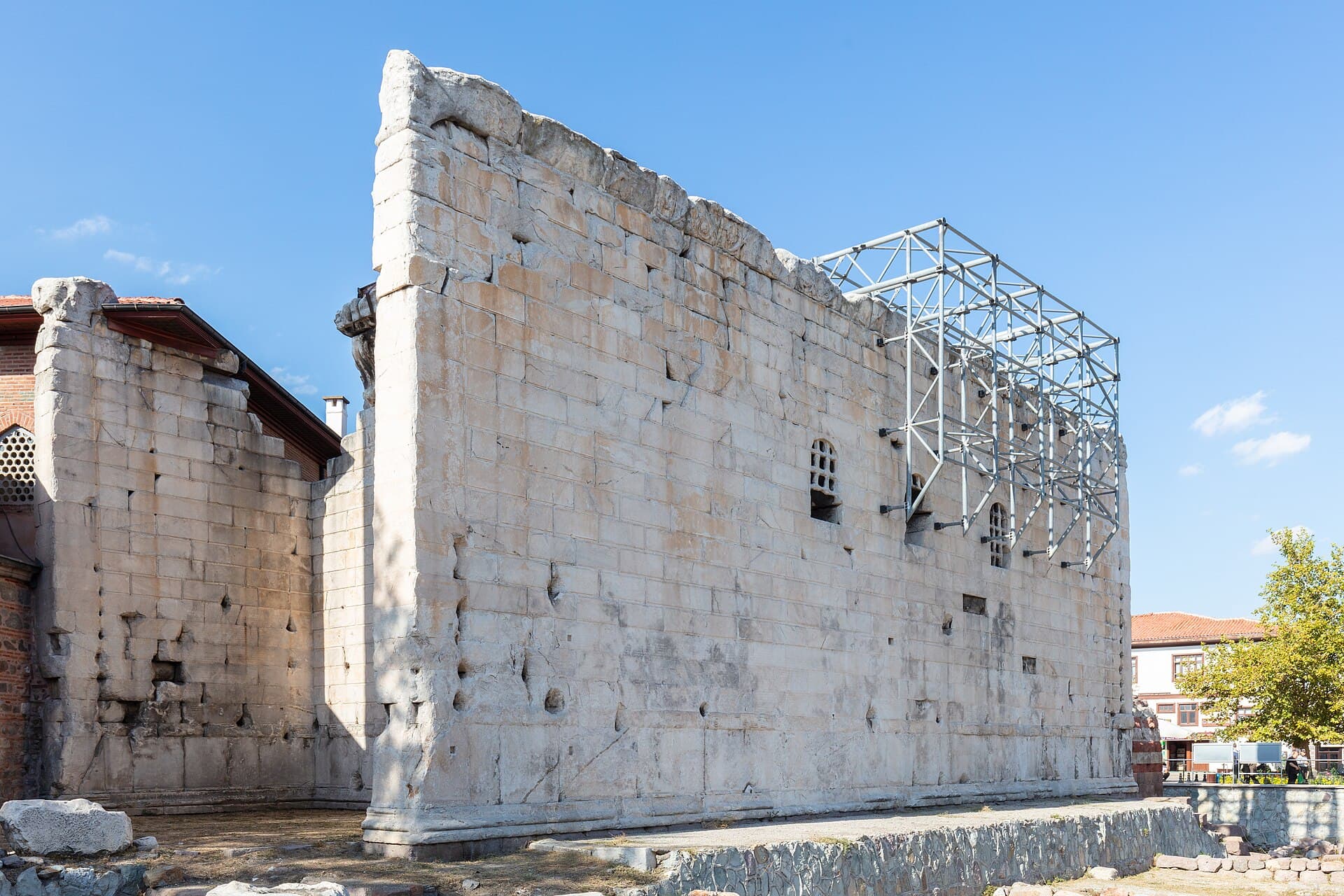
One standing wall of a Roman temple carries the most complete surviving copy anywhere of Augustus's own account of his reign.
Enough context, no spoilers
Why it matters
Built 25–20 BC as Ancyra's temple to Augustus and the goddess Roma, shortly after Rome annexed Galatia. After Augustus's death in AD 14, his political testament — the Res Gestae Divi Augusti — was inscribed on its walls: full Latin text on the pronaos, a Greek translation on the exterior. Rome's own copy has not survived; Ankara's is the most complete known.
What to know before you go
Set expectations before you come: there is very little building left here, and what remains is viewed through a fence, not walked into. If that were the whole story, this would not be worth the detour. It is not the whole story. After Rome absorbed Galatia into the empire, the provincial capital built a temple to Augustus and the goddess Roma, finished around 20 BC. When Augustus died in AD 14, the empire distributed his own account of his reign — the Res Gestae Divi Augusti, a first-person list of what he had built, conquered and given — to be inscribed publicly across the provinces. Almost all of those copies are lost, including the original set up in Rome itself. The version cut into the walls of this temple, in Latin inside the entrance porch and in a full Greek translation on the outer wall, is the most complete copy that survives anywhere. Historians reconstructing Augustus's own version of his reign are, to a real extent, reading Ankara. None of that is visible at a glance — the inscription is worn, in a dead language, and behind a rail — which is exactly why it is worth knowing the story before you arrive rather than after. What you can see clearly is the wall itself and, next to it, the reason the temple survived as well as it did: the Ottomans built Hacı Bayram Mosque directly against it in the 15th century, and the temple wall has stood as the mosque's neighbour ever since. A Roman emperor's political testament and a Sufi saint's mosque, sharing one wall, is as concise a summary of Anatolia's layered history as this city offers. Twenty minutes is enough. Combine it with the mosque next door, and with the walk up to Ankara Castle, which starts nearby — this corner of Ulus rewards being seen on foot, slowly, rather than as a single stop.