Çanakkale Martyrs' Memorial
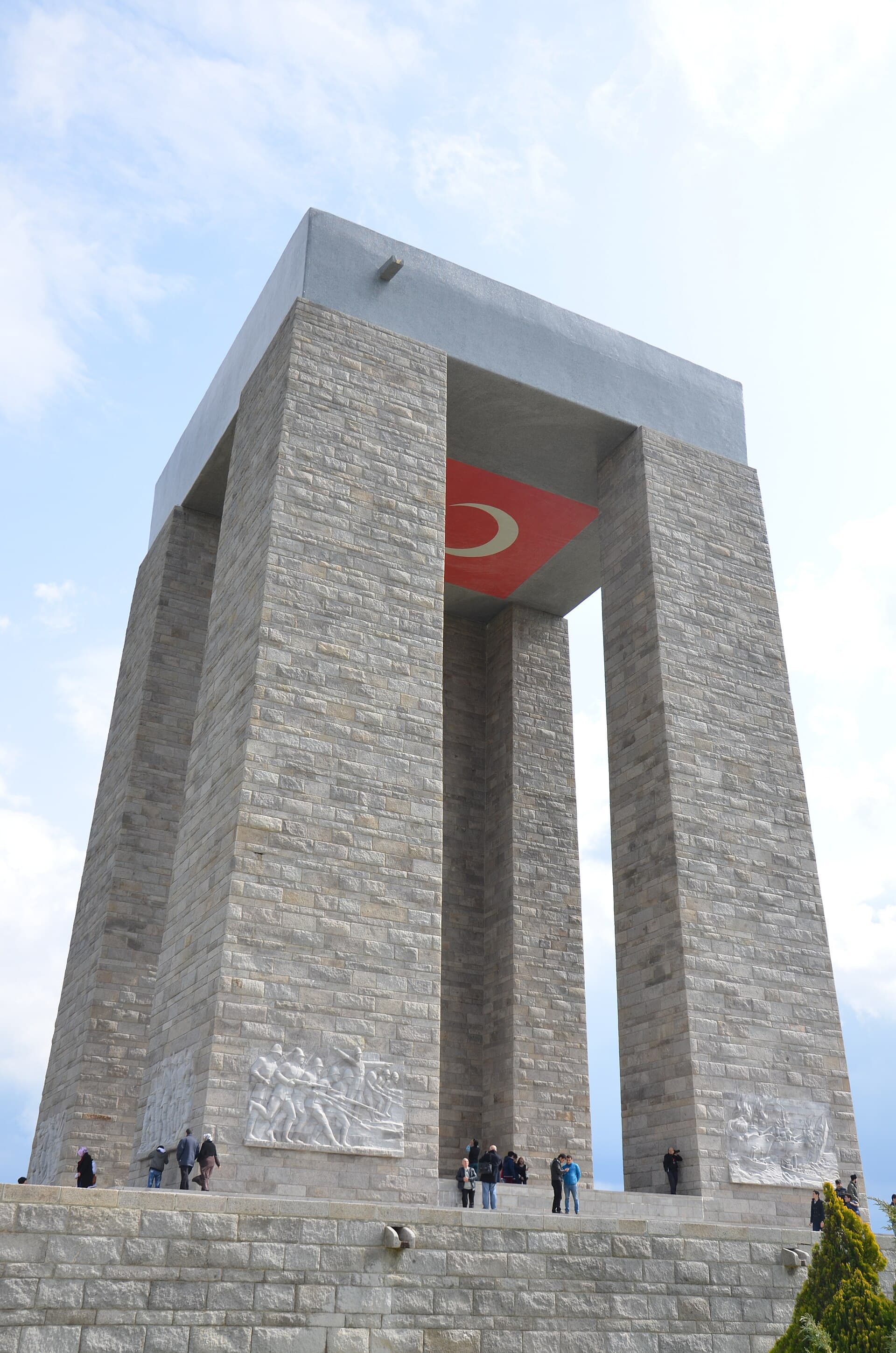
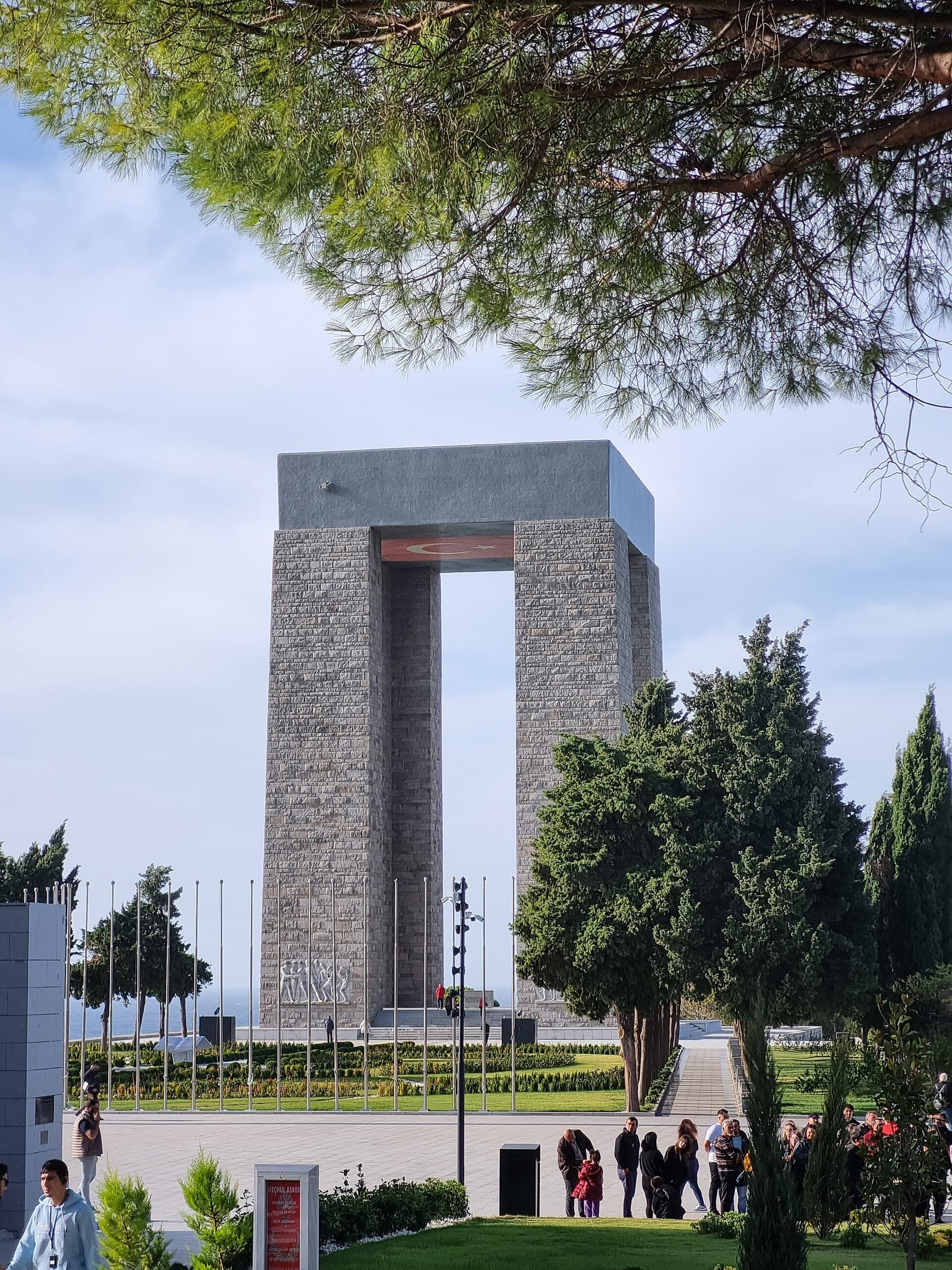
Four 42-metre legs holding a concrete roof over nothing — Türkiye's national monument to a battle that turned a general into a president.
Enough context, no spoilers
Why it matters
Designed after a 1944 competition and built between 1954 and 1960 on Hisarlık Hill above Morto Bay, this monument commemorates roughly 253,000 Turkish soldiers who fought the Gallipoli campaign. It appeared on the 500,000-lira banknote from 1993 to 2005 and remains the primary site of the annual 18 March Çanakkale Victory and Martyrs' Day state ceremony.
What to know before you go
Nothing about this monument is meant to be intimate. Four square legs, each seven and a half metres wide, rise almost 42 metres to carry a flat concrete slab, visible from ships passing through the Dardanelles below — this was built to answer the question of how a nation marks the loss of a quarter of a million of its men, and the answer it gives is scale. The design was chosen by competition in 1944, the foundation stone laid in 1954, and the monument finished in 1960, by which point Türkiye had spent over a decade turning a defensive campaign into its founding national story: this ridge is where the general who became Atatürk first proved himself, and the republic he built afterward never stopped tracing its legitimacy back to it. For four decades the monument appeared on the country's largest-denomination banknote. Each 18 March — the anniversary of the 1915 naval battle the Ottoman coastal batteries won against the Allied fleet, the failure that forced the doomed land campaign that followed — state officials lay wreaths here in a ceremony broadcast nationally. For domestic visitors it is the closest equivalent to what 25 April is for Australians and New Zealanders, and it belongs on this page for the same reason Anzac Day does.
A small museum beneath the monument holds uniforms, weapons and personal items recovered from the battlefield, worth the few extra minutes. It's also worth walking the short distance to the French National Cemetery nearby, on the same headland: 2,240 identified graves and four white ossuaries holding the unidentified remains of roughly 12,000 more French and French colonial soldiers, from an expeditionary force whose own losses here — well over 10,000 dead — are rarely mentioned outside French sources. Standing between the two memorials is the most direct way this peninsula has of making its real point: this hillside remembers a Turkish victory and an Allied catastrophe as the same event, from a few hundred metres apart, and neither monument asks you to forget the other is there.